Stephen Albert

Kale is a leafy cool-weather crop that requires two months of cool weather to reach harvest. Kale is a biennial plant, a hardy brassica (member of the cabbage/mustard family).
Mature kale leaves can be coarse but there are several types that are grown for their tender, palatable young leaves. Kale is an important leaf crop for early spring when the weather is too harsh for many other leafy crops. Some varieties are well-suited as autumn-to-spring crops, especially when grown under a cover–a cold frame or plastic tunnel.
Related articles:
- Seven Ways to Serve Kale
- Kale Seed Starting Tips
- How to Harvest and Store Kale
- How to Plant and Grow Kale
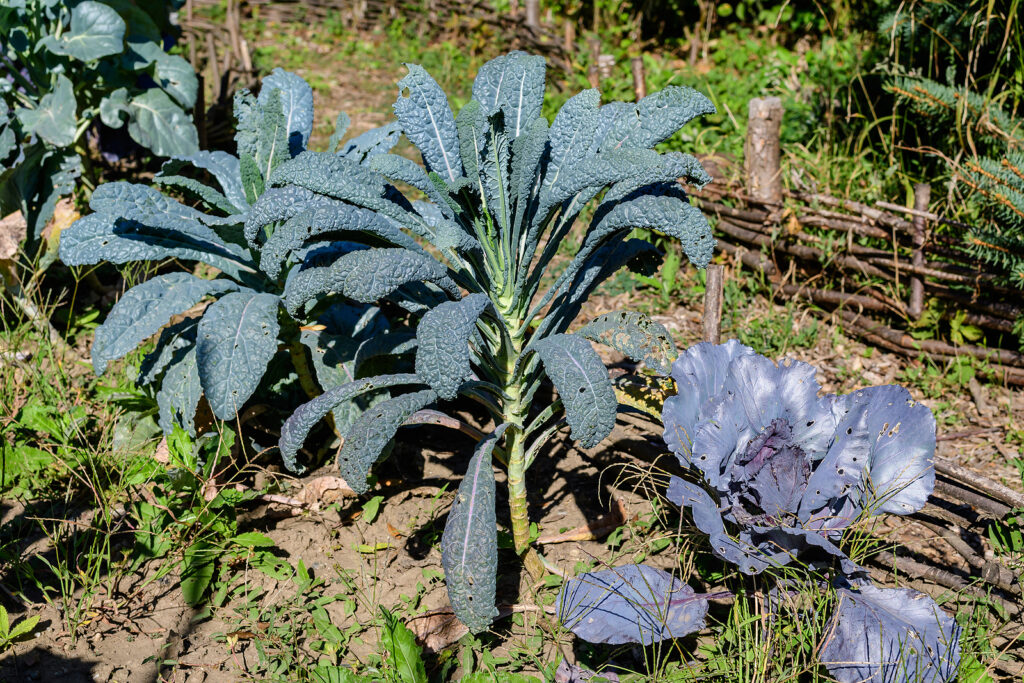
Kale can be used cooked or raw in salads.
Kale can grow to 24 inches (60cm) tall; the most common leaf color is green, but kale also comes in shades of blue-green and in variegated shades that range from red to white and yellow to white. Kale is usually free of pests and diseases.
Kales are non-heading members of the cabbage genus (family Cruciferae, order Brassica). Kale and collards are closely related, both with the botanical name Brassica oleracea acephala. Members of this group include curly or Scotch kales, Another member of the Brassica order is Brassica napus pabularia (actually a cousin of the rutabaga). Members of this group include Russian or Siberian kale; these have looser leaves and are more likely to be reddish-tinted, especially in cold weather.
Good Products at Amazon for Raised Bed Growing
- Galvanized Raised Bed 8×3
- Cedar Raised Bed 4×8
- Elevated Cedar Planter 4×2
- Walk-In Greenhouse Tunnel 15x7x7
- Row Cover for Freeze Protection 10×30
Here is your complete guide to growing kale!
Types of kale
There are five basic types of kale: curly kale (also called Scotch kale or borecole) with tightly curled leaves; broad-leaves kale (also called Siberian kale) with smoother leaves with frilled edges; Red Russian kale with frilly-edged blue-green leaves; black Tuscan kale (also called Dinosaur kale) with narrow almost blue leaves with a creped texture; and bicolored ornamental kales which are edible though commonly featured for their color in flower gardens.
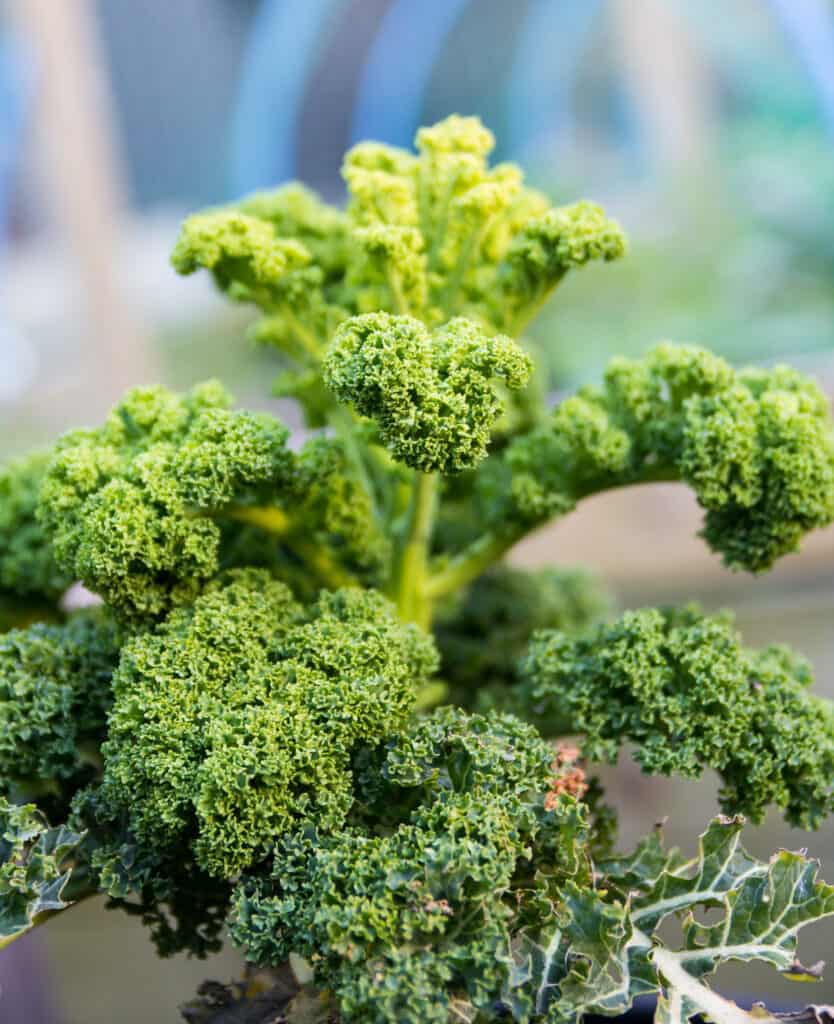
- Curly kale (Borecole, Scotch kale) is one of the hardiest members of the cabbage family. Curly kale has deeply crinkled green or blue leaves; some varieties have deep curled purple leaves. Curly kale is grown for both mature leaves and young spring soots. Tall varieties grow to 36 inches (90cm) tall; dwarf types grow to 12 inches (30cm) high. Varieties include the hybrids ‘Darkibor’, ‘Fribor’, ‘Showbor’ and ‘Winterbot’. ‘Redbor’ and ‘Garna Red’ have red leaves. ‘Dwarf Green Curled Afro’ is an heirloom variety. ‘Showbor’ and ‘Starbor’ and mini varieties.
- Broad-leaved kale has flat rather than curled leaves. Broad-leaved kale is grown primarily for its spring shoots. These kales are faster growing than curly kale. Varieties include ‘Pentland Brig’ and ‘Hungry Gap’.
- Red Russian kale has attractive, frilly-edged, blue-green leaves that develop distinct purple and red tints as temperatures fall. This kale is mild-flavored and smooth textured. It grows to 27 inches (70cm) tall. It grows to maturity in about 50 days.
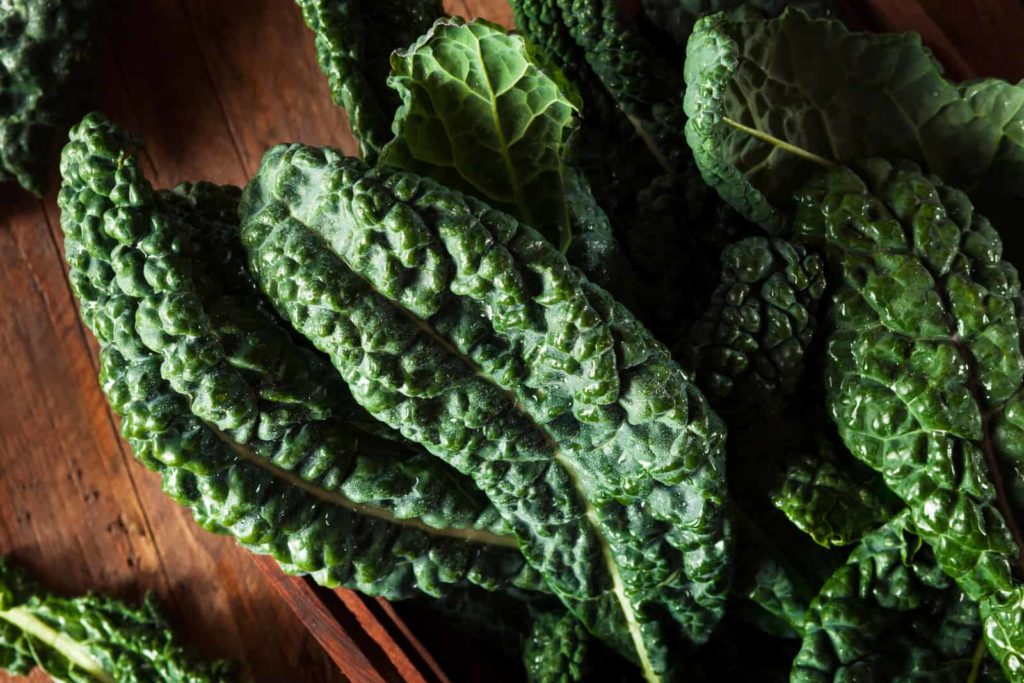
- Black Tuscan or Lancinato kale (also called black kale, black cabbage, Cavolo nero, palm cabbage, and dinosaur kale) produces tufts of long, narrow, almost blue leaves with creped texture. Black Tuscan kale is widely grown in Italy. It has distinctly flavored leaves often used in soups and in salads when picked young. It can grow to 4 feet (2m) tall. It grows to maturity in about 62 days.
- Ornamental kales and cabbages–these are highly decorative, brightly multicolored plants commonly grown as ornamental plants, but they can be used as a garnish. These have deeply serrated leaves. The colors deepen in cold weather.
Kale growing quick tips
- Kale grows best in regions where there are frosts. Kale is very cold-hardy. Kale does not like long periods of intense summer heat.
- Kale grows best when the average temperature ranges between 60° and 65°F.
- Kale is commonly started indoors and transplanted into the garden when seedlings are 4 to 6 weeks old.
- Sow seeds indoors or outdoors 4 to 6 weeks before the last frost in spring or as soon as the soil can be worked.
- Kale yield: plant 4 to 5 plants per household member.
Where to plant kale
- Plant kale in full sun; plant kale in partial shade in warm regions. For optimal flavor, grow kale in cool weather.
- Plant kale with humus-rich, well-drained soil with a soil pH between 6.5 and 6.8.
- Kale grows best in loamy soil; add a moderate amount of well-rotted manure or compost to the planting bed ahead of plants.
- The flavor and texture of kale will decline when grown in light, sandy soils or heavy, clayey soils.
- Soil too rich in nitrogen can cause kale to grow extra-succulent which in turn can attract pests.
Kale planting time
- Kale is a cool-weather crop that can tolerate temperatures as low as 20°F (-6.7°C). Kale does not tolerate heat.
- Direct seed or transplant kale into the garden so that it comes to harvest before daytime temperatures exceed 80°F (26°C).
- Soil temperature must be at least 40°F for good germination of kale seeds.
- Start kale transplants indoors 6 to 8 weeks before the time you want to set them in the garden.
- Sow seed in the garden 4 to 6 weeks before the last frost in spring
- Set kale transplants in the garden from 5 weeks before to 2 weeks after the last frost in spring.
- In cool-summer regions, plant kale in early spring for summer to early fall harvest.
- In warm- and hot-summer regions, plant kale in late summer for harvest in late fall or winter.
- In mild-winter regions, kale can be sown in the fall for winter harvest.
- For a fall harvest sow seeds about 10 weeks before the first expected fall frost.
Good Products at Amazon for Seed Starting Success:
- Jump Start Germination Station w/Heat Mat Tray, 72-Cell Pack, Dome
- Espoma Seed Starting Mix
- 200 Count- Jiffy 7 Peat Soil Seed Starting Plugs
- Seed Starter Kit with Humidity Dome (120 Cells Total Tray)
- AgrobriteT5 Fluorescent, 2-Foot, Grow Light System
Planting and spacing kale
- Sow kale seed ½ inch (12mm) deep and spaced 3 inches (7cm) apart. (Kale seed is viable for 5 years.)
- Thin kale seedlings to 12 inches (30cm) to 15 inches apart when they are 4 to 5 inches (10-12cm) tall.
- Space rows 18 to 24 inches (45-61cm) apart.
- In growing beds with equidistant planting, set plants 15 to 18 inches apart.
- Set transplants with crooked stems up to the first leaves.
- Space dwarf or mini kales 6 to 8 inches (15-20cm) apart.
Growing kale in winter
- Kale can be grown under cover–in a cold frame, plastic tunnel, or row cover– through the winter.
- Where plants overwinter under cover, continue picking leaves through the winter and into spring. Growing kale under cover in winter will make leaves more tender.
- You can overwinter kale in the garden with a protective mulch.
- In fall, pull earth up around the stem to the level of the lowest leaves then mulch thickly with straw or chopped leaves when frost is forecast.
- Kale that is well-covered will survive through the winter and even produce an early crop of new leaves in spring.
- In mild winter regions, kale can be harvested through the winter.
- Kale is a biennial and will start to grow again in the spring.
More tips: Kale Seed Starting Tips.
Watering kale
- Keep kale well-watered for sustained growth and to keep leaves from getting too tough.
- Kale prefers damp, not soggy, soil.
- Be sure to water during the early stages of growth to ensure plants become well-established.
Feeding kale
- Add nutrient-rich aged compost to planting beds in advance of planting.
- When kale seedlings are 4 to 5 inches tall, side-dress them with nitrogen-rich fertilizer such as rotted manure or blood meal, or water with manure tea.
- Side-dress kale with aged compost every 6 weeks.
- Overwintered plants should be fed with a seaweed-based fertilizer in spring to stimulate new growth.
Kale companion plants
- Good companion plants for kale include beets, celery, herbs, onions, and potatoes.
- Do not plant kale with pole beans, strawberries, or tomatoes.
Caring for kale
- Kale is a very low-maintenance crop.
- Keep the planting bed weed free for kale.
- Remove any old or rotting lower leaves as necessary.
- Apply mulch around kale once plants are well-established.
- Mound straw around kale once it is 6 inches (15cm) high to prevent plants from touching the soil; soil easily sticks to kale’s often crinkled leaves.
- Dwarf plants can be covered with cloches or crop covers in autumn to make the leaves more tender.
Container growing kale
- Kale will grow best in a 12-inch diameter (30 cm) container that is at least 12 inches deep. There should be at least 3 gallons of soil in the pot.
- Plant kale on 8-inch (20cm) centers in large containers.
- Move kale grown in containers into the cool shade when the weather warms to extend the season.
Good Products at Amazon For Growing Kale and Cabbage Family Crops:
- Neem Bliss 100% Cold Pressed Neem Oil
- Monterey BT Caterpillar Killer
- Safer Brand Insect Killing Soap
- PyGanic Botanical Insecticide
- Captain Jack’s Dead Bug Brew
- Live Ladybugs
- Natures Good Guys Beneficial Nematodes
- Yellow Sticky Traps
- Southern Ag Liquid Copper Fungicide
- MycoStop Biofungicide
Kale pests
- Kale can be attacked by cutworms, cabbage loopers, and imported cabbage worms. Control these pests by handpicking or spry with Bacillus thuringiensis.
- Flea beetles can nibble holes in young kale leaves. Spray with insecticidal soap as soon as noticed.
- Mealy aphids are grey-green waxy-looking aphids that suck leaves causing puckering. Squash by hand or spray with insecticidal soap.
- Cabbage whiteflies are small white insects; spray with insecticidal soap.
- Caterpillars come from eggs laid by cabbage white butterflies; caterpillars eat leaves. Squash or spray with insecticidal soap.
- Cabbage root fly lays eggs at the base of plants; grubs hatch and tunnel into roots. Plants must be uprooted and disposed of.
- Slugs and snails can damage young plants; handpick and destroy these pests.
Kale diseases
- Kale typically does not suffer from diseases.
- Kale may be infected with a soil-borne disease called clubroot. Plants will collapse and die. Diseased plants should be lifted and placed in the garbage, not the compost pile. Crop rotation can eventually eliminate this disease.
Kale harvest
You can harvest kale leaves as soon as they are big enough to eat or let them mature on the plant. Older, outer leaves exposed to more sunlight will be rich in vitamin C and calcium. Harvest kale leaves cut-and-come-again to keep the plant producing or take the entire plant.
- Kale will be ready for harvest 55 days from transplanting, and 70 to 80 days from seed.
- There are two ways to harvest kale; you can pick individual leaf rosettes for a cut-and-come-again crop, or cut the entire plant.
- Peak harvest time for kale is when the leaves are firm, crisp, and bright-colored. Young and just mature plants have the most tender leaves. Old leaves will lose their luster and become tough and bitter.
- The tenderest leaves are those in the just-opening rosette at the top of the plant. Leaves on the uppermost part of the plant are more tender than those at the bottom.
- Pick the outside leaves first and let the center leaves grow on if you want a continuous harvest.
- Cut individual leaves for use when the plant is 8 to 10 inches high; cut the outside leaves first.
- Picking a few leaves at a time will encourage fresh growth and prolong the season.
- Stop picking individual leaves when warm weather comes and flower buds form or stems become coarse.
- If you harvest the entire plant, cut 2 inches above the soil and the plant will sprout new leaves in 1 to 2 weeks.
- Delaying the kale harvest until after the first frost will greatly enhance the flavor.
- Harvest kale before it gets old and tough. Young plants and tender leaves have the best flavor and texture.
How to prepare kale
Cool- and cold-weather kale can be served almost like summer-tender spinach: cut out the center ribs of young kale and use the leaves cut into strips as salad greens; dice the ribs and add them to the salad for a bit of crunch.
Cook kale leaves just out of the garden only a few minutes longer than spinach. And in the dead of a winter cut frozen kale leaves from the plant and cook them before they thaw; the flavor will not suffer.
One pound of kale with stems will serve 2 to 3 people. Without stems, one pound will serve 3 to 4 people.
Kale can be prepared just as you would spinach.
Kale salad: Baby leaf kale has a much more tender texture and milder sweet flavor than mature kale. Eat baby leaf kale raw in a salad alone or mixed with other greens; simply dress kale with oil and vinegar.
Kale holds up well when steamed, braised, stir-fried, or sautéed.
More tips: How to Harvest and Store Kale.
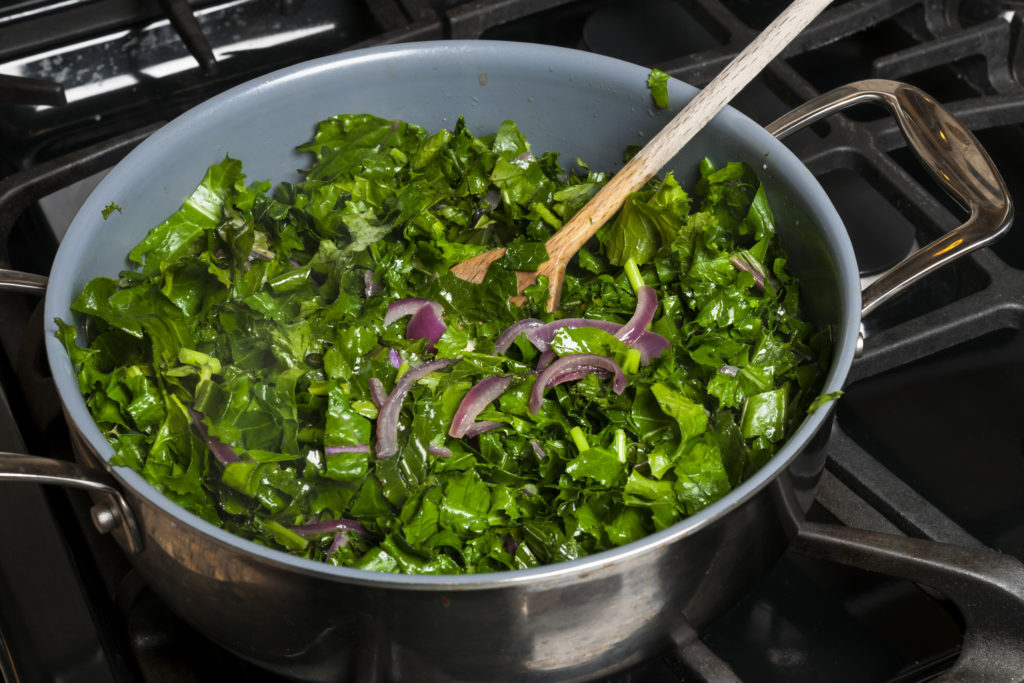
How to prepare kale for cooking
- Wash the leaves in a large bowl of water to dislodge sand and dirt. Add vinegar or salt to the water to dislodge any insects.
- Rinse the leaves under cold running water.
- Remove the tough center stalk by folding the leaves in half and ripping the stalk out then gather up the greens and roll them like a cigar then slice them into ribbons.
- Don’t dry the leaves before cooking. Use the residual water on the leaves to help wilt the leaves as they cook.
Steam kale leaves in just the water that remains after the leaves have been washed. Steam only long enough for the leaves to wilt: 3 to 6 minutes. Italian style: steam kale until tender, then add olive oil, a little garlic, and breadcrumbs, and sprinkle it with Parmesan cheese in the last minute or two of cooking.
Blanch kale strips in salted water for 1 minute, drain, then sauté in olive or nut oil, butter, or with bacon or pancetta, season with olives, garlic, chili, cumin, caraway, fennel, anise, or toasted sesame oil.
Stir-fry kale with a few slices of fresh ginger root, for about 1 minute. Or stir-fry in sesame oil with minced garlic for 3 minutes, tossing with sliced mushrooms.
Braise kale in stock if you want the strong flavor to match grilled sausage or frankfurters served with potatoes.
The strong flavor of mature kale leaves goes well in soups and stews. In India, kale is often teamed with hot spices.
Kale can be seasoned with salt, pepper, onion, garlic, basil, dill, mace, nutmeg, allspice, mustard, parsley, sage, rosemary, or thyme.
Storing and preserving kale
- Leave kale in the garden until you are ready to use it. Its flavor will be sweetened by frost.
- Kale will keep in the refrigerator for 1 to 2 weeks in a plastic bag.
- Kale can also be frozen, canned, or dried.
Saving kale seeds
- Kale is a bee-pollinated biennial.
- To save seeds of open-pollinated varieties, allow the plant to go to flower and go to seed–which you can collect.
- Seeds are viable for about 5 years.
Kale in the kitchen
- Kale is commonly cooked but sometimes eaten raw though the flavor of raw kale can be strong and pungent
- Small amounts of raw, young, tender kale can be added to salads to add a spicy note. Apart from young leaves, kale leaves are too coarse for salads.
- Wash leaves carefully and discard the hard pieces of stalk.
- Kale can be chopped and added to soups and stews.
- Use the tough outer leaves for soups; use the tender inner leaves for salads.
- Steam kale leaves and serve with butter, lemon juice, and chopped bacon.
- Kale can be cooked with pork, like cabbage.
- Cook kale in salted water until tender, drain and chop fine, and return to the pan with butter, salt, and pepper to taste.
- Caldo Verde is a staple dish in Portugal; it is a soup of kale, potatoes, and spicy sausage. A vegetarian version replaces the sausage with garlic and olive oil.
- Brose is an old-time Scottish soup that is kale and beef broth, thickened with a handful of toasted rolled oats.
- Kale is a good source of vitamins A and C, as well as being rich in calcium.
Types of kale
There are three basic types of kale: Scotch kale (called borecole) with tightly curled leaves; Siberian kale with smoother leaves with frilled edges; and bicolored ornamental types which are edible though commonly featured for their color in flower gardens.
Curly Type
- ‘Blue Curled Scotch’ is a compact, low-growing plant 12 inches tall; with blue-green finely curled leaves; matures in 65 days.
- ‘Dwarf Green Curled’ is extremely hardy, can withstand severe frost; grows to 15 inches tall and 30 inches wide with white ribbed yellow-green leaves; matures in 50 to 65 days.
- ‘Vates’ also called ‘Dwarf Blue Curled’ is the standard dwarf curled variety; compact, low-growing to 12 inches tall; can withstand below-freezing temperatures; blue-green curled leaves; 55 days to maturity.
Broad-leaved Type
- ‘Blue Siberian’ is a hardy, vigorous grower well-suited for warm regions; frilled leaves; grows to 16 inches tall and 36 inches wide; 65 days to maturity.
- ‘Dwarf Siberian’ has a thick head of frilled gray-green leaves; can withstand cold temperatures; grows 12 to 16 inches tall; 65 days to maturity.
- ‘Hungry Gap’ is a very hardy plant that can withstand drought wet periods and frost 65 days to maturity.
Red Russian Kale
- Red Russian is heirloom kale.
- Grayish green leaves resemble the foliage of oak trees but are much larger. In cold weather, the stems and veins turn a lavender color.
- Red Russian kale grows 2 to 3 feet tall.
Black Tuscan or Lancinato Kale
- Black Tuscan is an Italian heirloom.
- Leaves are very dark green with a puckered surface and edges that curl under.
- Black Tuscan grows in a fountain shape to about 2 feet tall.
Other Varieties to Grow
- ‘Blue Armor’ (45-75 days, hybrid); ‘Blue Knight’ (55 days, hybrid); ‘Dwarf Blue Scotch’ (55 days); ‘Greenpeace’ (65 days); ‘Hanover Late Seedling’ (68 days); ‘Konserva’ (60 days); ‘Squire’ (60 days); ‘Verdura’ (60 days); ‘Winterbor’ (60-65 days, hybrid).
Best kale varieties to grow
There are a couple of dozen different varieties of kale. Here are six easy-to-grow varieties that are especially tasty (you will like any one of these!):
- Blue Curled Scotch: curly blue-green leaves; tender and extremely tasty; rich in Vitamin A; easy to grow; very cold hardy; grows just over 1 foot tall; harvest in 50 to 60 days or as baby leaf kale in 25 to 30 days; open-pollinated heirloom from Scotland. Dwarf Blue Curled Scotch grows to 15 inches tall.
- Lacinato: crinkled, deep blue-green leaves; sweet, full flavor—mild, never strong-flavored; best harvested young after the first frost; Italian heirloom dates to 18th century also called Tuscan or Toscano kale (for its origin) and Dinosaur kale (for its primitive look); grows 2 to 3 feet tall; cold and heat tolerant; harvest in 45 to 50 days; open-pollinated.
- Red Russian: wide, flattened, oak-like, dark green leaves with purple-red veins; more tender than other kale; use in salads, steamed, and light cooking; can be a tad bitter when cooked; 2 to 3 feet tall; cold and heat tolerant; harvest in 40 to 60 day; open-pollinated.
- Siberian: extra curly blue-green leaves; tender and mild-flavored perfect for salads or blanch or stir-fry; flavor sweetened by frost; 1½ to 3 feet tall; very cold hardy; harvest in 60 days; open-pollinated.
- White Russian: deeply cut, frilly, dark green leaves with white veins; tender, sweet flavor; very cold hardy, and heat tolerant; tolerates wet soil; 2 to 3 feet tall; harvest full-size in 50 days; harvest gourmet baby leaves in 25 days; open-pollinated.
- Winterbor: curled and ruffled blue-green leaves; tender, sweet, and extra mild flavored; 2 to 3 feet tall; very cold hardy; harvest in 60 to 65 days; hybrid.
About kale
- Common name. Kale, borecole (borecole is used in British seed catalogs)
- Botanical name. Brassica oleracea acephala
- Origin. Hybrid
Kale articles on Harvest to Table:
Garden Planning Books at Amazon:
- Vegetable Garden Almanac & Planner
- Kitchen Garden Grower’s Guide Vegetable Encyclopedia
- Vegetable Garden Grower’s Guide
- Tomato Grower’s Answer Book
Save Money Growing Veggies: KITCHEN GARDEN GROWERS’ GUIDE
More how to grow articles:
Learn how to plant, grow, and harvest your favorite vegetables. Click below for all you need to know.
- Artichoke
- Arugula
- Asparagus
- Beans, Snap
- Beets
- Broad Beans
- Broccoli
- Brussels Sprouts
- Cabbage
- Cantaloupe — Melons
- Cardoon
- Carrots
- Cauliflower
- Celeriac
- Celery
- Chard
- Chayote Squash
- Chickpeas
- Chicory
- Chinese Cabbage
- Collards
- Corn Salad
- Corn, Sweet
- Cresses
- Cucumbers
- Eggplant
- Endive and Escarole
- Fava Beans
- Florence Fennel
- Garbanzo Beans
- Garlic
- Horseradish
- Jerusalem Artichoke
- Kale
- Kohlrabi
- Leeks
- Lettuce
- Lima Beans
- Melons
- Mizuna
- Mustard Greens
- New Zealand Spinach
- Okra
- Onions
- Parsnips
- Peanuts
- Peas
- Peppers
- Potatoes
- Pumpkins
- Radicchio
- Radishes
- Rhubarb
- Rutabaga
- Salsify
- Shallots
- Sorrel
- Southern Peas
- Soybeans
- Spinach
- Squash, Summer
- Squash, Winter
- Sunchokes
- Sweet Potato
- Swiss Chard
- Taro
- Tomatillo
- Tomatoes
- Turnips
- Watermelon
- Zucchini