Stephen Albert

You can learn to grow thyme in a matter of minutes. Thyme is one of the most commonly used culinary herbs. Its subtle aroma and flavor add complexity to many dishes. Thyme is used in cooking to add flavor to vegetables, meat, poultry, and fish dishes, soups, and cream sauces. Thyme is often used with tomatoes and dishes with tomato sauce, as well as with eggplant, onions, and green beans. Lemon-scented thyme enhances the flavor of fish, chicken, and veal.
Here is your complete guide to growing thyme.
Where to plant thyme
- Best location: Plant thyme in full sun. Thyme does not grow well in cold or wet soil. In hot summer regions, plant thyme so that it gets light afternoon shade.
- Soil preparation: Thyme grows best in well-drained slightly sandy soil. Soil too rich in organic matter will produce plants that are large but less fragrant. Thyme prefers a soil pH of 6.0 to 6.7.
Articles of interest:
- How to Grow Herbs
- How to Start an Herb Garden
- Best Herbs for Container Growing
- Herbs for Cool Season Growing
- Grow 20 Herbs for Cooking
When to plant thyme
- Seed starting indoors: Sow thyme indoors as early as 3 to 4 weeks before the last frost in spring. Start seeds indoors at a soil temperature of 70°F under fluorescent lights. Seeds can take as long as 30 days to germinate.
- Transplanting to the garden: Transplant thyme seedlings to the garden once the last frost has passed. Thyme can also be grown from cuttings or divisions taken in spring or early summer.
- Outdoor planting time: Thyme can be sown outdoors as soon the soil can be worked in spring, usually 3 or 4 weeks before the last frost. You can take cuttings or divide older plants in spring.
- Planting depth: Planting and spacing. Sow thyme seeds ¼ inch deep.
- Spacing: Thin seedlings to 12 inches apart when they are 2 to 3 inches tall. Space rows 16 to 24 inches apart.
- How much to plant: Grow 6 plants for cooking; grow 10 to 18 plants for preserving.
Thyme companion plants
- Companion planting: Thyme is said to benefit all cabbage family plants, eggplant, potatoes, strawberries, and tomatoes. Plant thyme with hyssop, garlic, chives, and rosemary. The fragrance of thyme is said to repel pest insects and mask the smell of plants that attract pest insects.
Watering and feeding thyme
- Watering: Keep the soil evenly moist until plants are well-rooted. Thyme requires little watering once established; once established thyme grows best in soil that is on the dry side.
- Feeding: Spray foliage with compost tea 2 or 3 times during the growing season. Scratch a teaspoon of cottonseed or bonemeal around the base of each plant at the start of the season.
Thyme care and maintenance
- Care: Keep planting beds weed-free. To keep thyme from becoming woody, prune plants back by one-third in spring and again after flowering in summer. Divide thyme every three years so that they do not become woody.
- Mulching: Protect plants from freezes with a mulch of chopped leaves, straw, or evergreen branches.
Container growing thyme
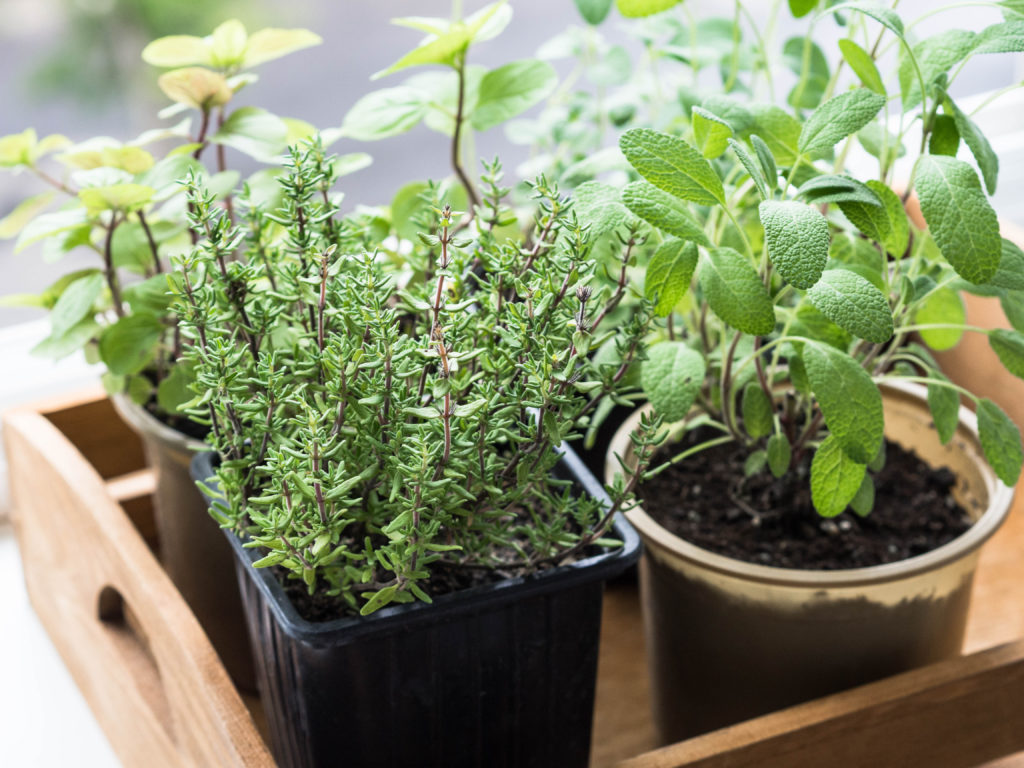
- Container growing: Thyme grows easily in containers. Choose a container with a minimum soil depth of 6 inches. Over-winter containers in a protected place.
- Winter growing: Bring thyme indoors in winter for winter harvest or start plants indoors for growing through the winter. Protect outdoor plants under a layer of mulch—chopped leaves or straw—in winter.
Thyme pests and diseases
- Pests: Aphids, mealybugs, spider mites may attack thyme; knock insect pests off of plants with a strong stream of water or spray pests with insecticidal soap.
- Diseases: Thyme is susceptible to fungal diseases and root rot. Avoid root rot by keeping plants out of wet areas. Botrytis rot can be treated with a fungicide; avoid planting plants too close together.
How to harvest thyme
- When to harvest: Snip thyme leaves as needed once plants are 6 to 8 inches tall. The flavor of thyme leaves will be most intense before the flowers open. For drying, harvest plants when they begin to bloom.
- How to harvest: Snip leaves with a garden snip or scissors. Trim back the tops of woody branches with a garden pruner. Cut back thyme to about 3 inches high twice during the growing season to encourage vigorous growth.
Thyme in the kitchen
- Flavor and aroma: The flavor of thyme is a bit earthy with lemony, peppery, and minty tones. The aroma of thyme can be described as earthy; it is subtle, unlike other herbs. Thyme is considered a “background” herb; it is rarely the major seasoning in a dish but it adds complexity.
- Leaves: Use leaves to accent many dishes. Fresh or dried leaves can be added to salads, sauces, stocks, soups, stews, stuffings, beef, pork, poultry, fish, seafood, sausages, vegetables, honey, cheeses, eggs, rice, grains, bread, beans, dressings, and vinegar.
- Flowers: Use flowers in salads as a garnish.
- Culinary companions: Thyme complements garlic, onions, and lemon.
Preserving and storing thyme
- Refrigeration: Refrigerate fresh thyme in a damp paper towel overwrapped in plastic; it will keep for one to two weeks in the vegetable crisper.
- Drying: Dry leaves separate from stems on a screen or clip stems and hang them upside down to dry in a warm, airy place. Leaves will dry in 2 to 7 days. You can dry leaves in the refrigerator; wash sprigs and place them in the refrigerator on a paper towel-lined tray.
- Freezing: Freeze leaves in a sealable plastic bag.
- Storing: Store dry leaves in an airtight container or bag.
Thyme propagation
- Seed: Sow thyme seeds indoors at 70°F. Seeds will germinate in about a week.
- Division: Divide roots of older, established plants from mid-spring to early summer.
- Cuttings: Cuttings are easy to root; use tip growth cuttings. Dip the ends of 4 to 6-inch cuttings in liquid rooting hormone and plant them in organic potting mix or sand under fluorescent lights. Cuttings will root in about 4 weeks.
- Layering: New plants can be started by weighing down outer branches and covering them with soil; roots will grow from nodes along the stem. The new plants can be transplanted in the fall or following spring.
Thyme varieties to grow
There are more than 400 species of thyme; 60 varieties of thyme can be used for cooking. Here are a few:
- Thymus camphorates: 6 to 12 inches high; has a strong camphor scent.
- Thymus caespititius: prostrate, mounding, light green foliage.
- Lemon thyme( Thymus citriodorus): grows to 12 inches high and is shrubby like common thyme but with slightly larger and broader leaves; rich lemon scent.
- Golden lemon thyme(T. c. ‘Aureau’): a creeping plant with a lemon fragrance.
- Thymus doerfleri: prostrate grower, woolly gray leaves, lavender flowers.
- Loevyanus thyme( Thymus glabrescens): low growing, gray leaves, purple flowers.
- Caraway-scented thyme( Thymus herba-barona): dark green leaves, pink flowers; caraway fragrance.
- Mother-of-thyme (Thymus praceoxarcticus): is strongly aromatic; it grows 6-inch branches from a stem that hugs the ground.
- Wooly thyme ( Thymus pseudolanuginosus: grows mat-like to 2 or 3 inches high; small gray leaves are woolly; produces small pink flowers.
- Thymus nitidus: grows to 10 inches tall with white flowers.
- Thymus nummularius: shiny, dark green leaves, rose-pink flowers.
- Marschallianus thyme( Thymus pannonicus): prostrate ground cover, rose-lavender flowers.
- Mother-of-Thyme or creeping thyme( Thymus praecox arcticus): to 6 inches high, blue-gray fuzzy leaves.
- Creeping white thyme( Thymus p. ‘Albus’): grows to 2 inches high, white flowers.
- Coconut thyme( Thymus p. ‘Coccineus): glossy, dark blue-green leaves, pink flowers.
- Woolly thyme( Thymus pseudolanuginosus): grows to 3 inches high, soft, woolly leaves.
- Common thyme or garden thyme( Thymus vulgaris): 6 to 12 inches high; small gray leaves, white to lilac flowers.
- Silver thyme(Thymus v. ‘Argenteus’): silver and green foliage, lemon-scented.
- Thymus vulgaris‘Aureus’: variegated yellow-green foliage.
- Thymus vulgaris‘Fragrantissimus’: fragrant gray foliage.
- English thyme( Thymus v. ‘Narrowleaf English’): grows to 8 inches high, narrow, bright green leaves.
- French thyme( Thymus v. ‘Narrowleaf French’: grows to 12 inches tall, narrow, gray leaves.
- Orange thyme( Thymus v. ‘OrangeBalsam’): narrow leaves, orange-scented.
Get to know thyme
- Botanical name and family: Thymus vulgaris or common thyme is the species commonly used as a seasoning, but there are several Thymusspecies—see below. Thyme is a member of the Lamiaceae or mint family.
- Origin: Mediterranean
- Type of plant: Thyme is a semi-woody, shrubby perennial.
- Growing season: Summer
- Growing zones: Zone 5 to 11
- Hardiness: Thyme tolerates both heat and cold; it is cold hardy to -20°
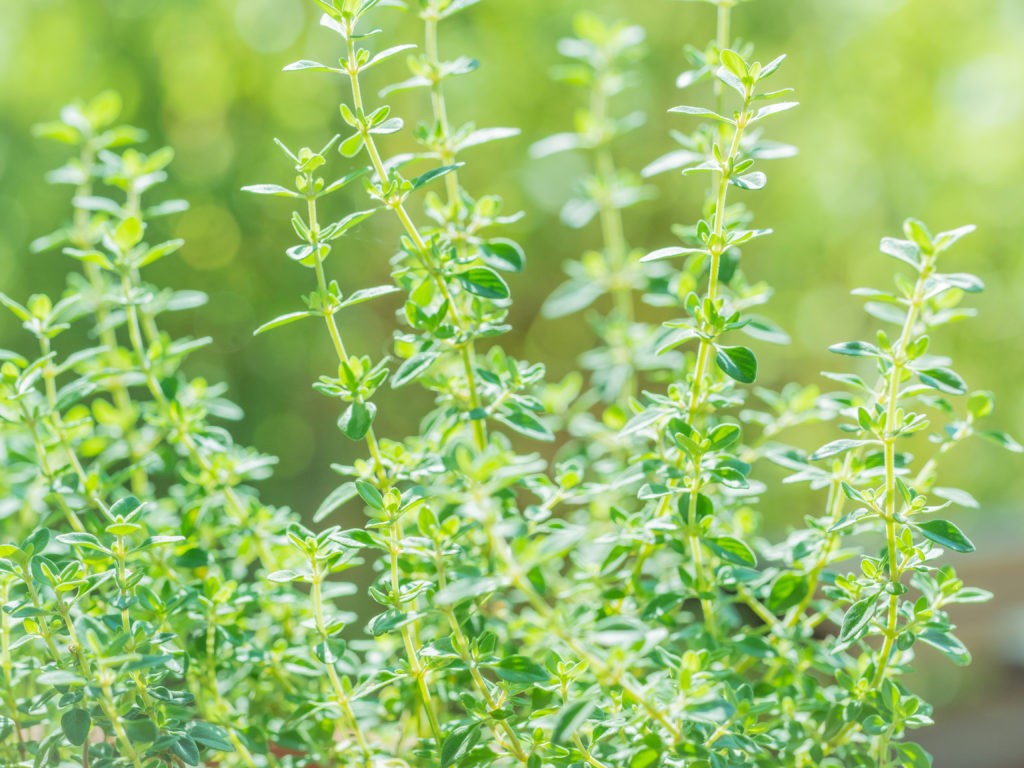
- Plant form and size: Common thyme is shrubby and grows 6 to 12 inches high. It has many-branched stems, some woody.
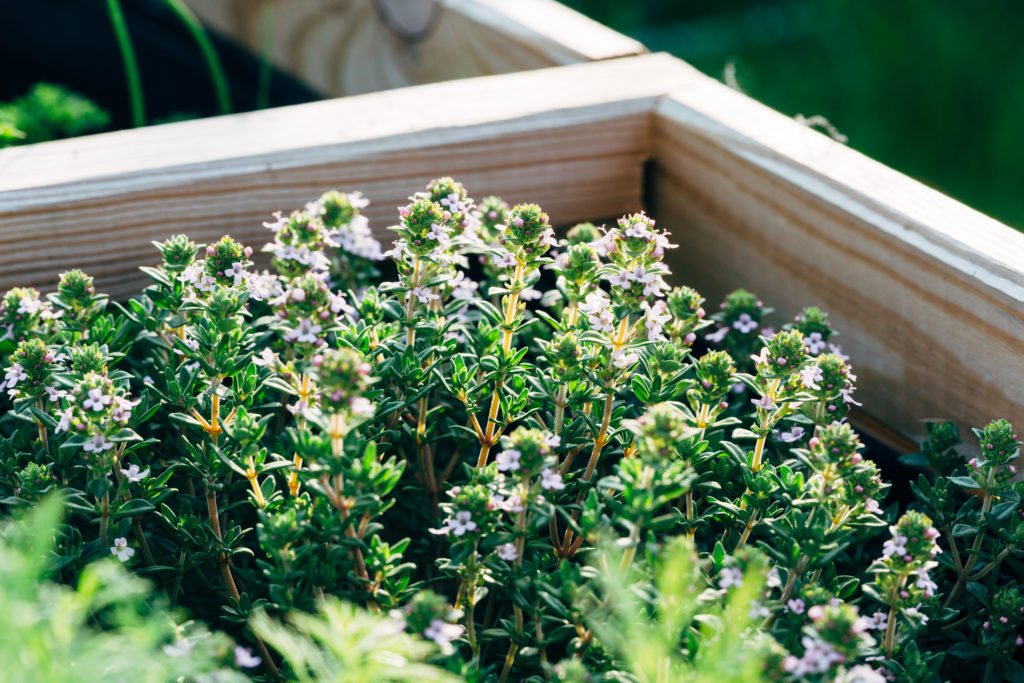
- Flowers: Tiny, tubular white, lilac and pink blossoms grow in loose spikes at the end of stems.
- Bloom time: Summer
- Leaves: Thyme has small, ¼-inch long, oval, pointed, gray-green leaves on long, wiry, four-sided stems.
Also of interest:
- Anise
- Anise Hyssop
- Arugula
- Basil
- Bay
- Bee Balm
- Borage
- Calendula
- Caraway
- Catnip
- Chamomile
- Chervil
- Chives
- Cilantro-Coriander
- Clary
- Costmary
- Cress
- Dill
- Fennel, Sweet
- Horseradish
- Hyssop
- Lavender
- Lemon Balm
- Lemongrass
- Lemon Verbena
- Lovage
- Marjoram
- Mint
- Nasturtium
- Oregano
- Parsley
- Perilla
- Rosemary
- Sage
- Salad Burnet
- Savory
- Scented Geranium
- Shiso
- Sorrel
- Stevia
- Sweet Cicely
- Tarragon
- Thyme
Related articles:
Best Herbs for Container Growing
Planning the Home Fruit Garden
Garden Planning Books at Amazon:
- Vegetable Garden Almanac & Planner
- Kitchen Garden Grower’s Guide Vegetable Encyclopedia
- Vegetable Garden Grower’s Guide
- Tomato Grower’s Answer Book