How to Grow Lithops — Living Stones

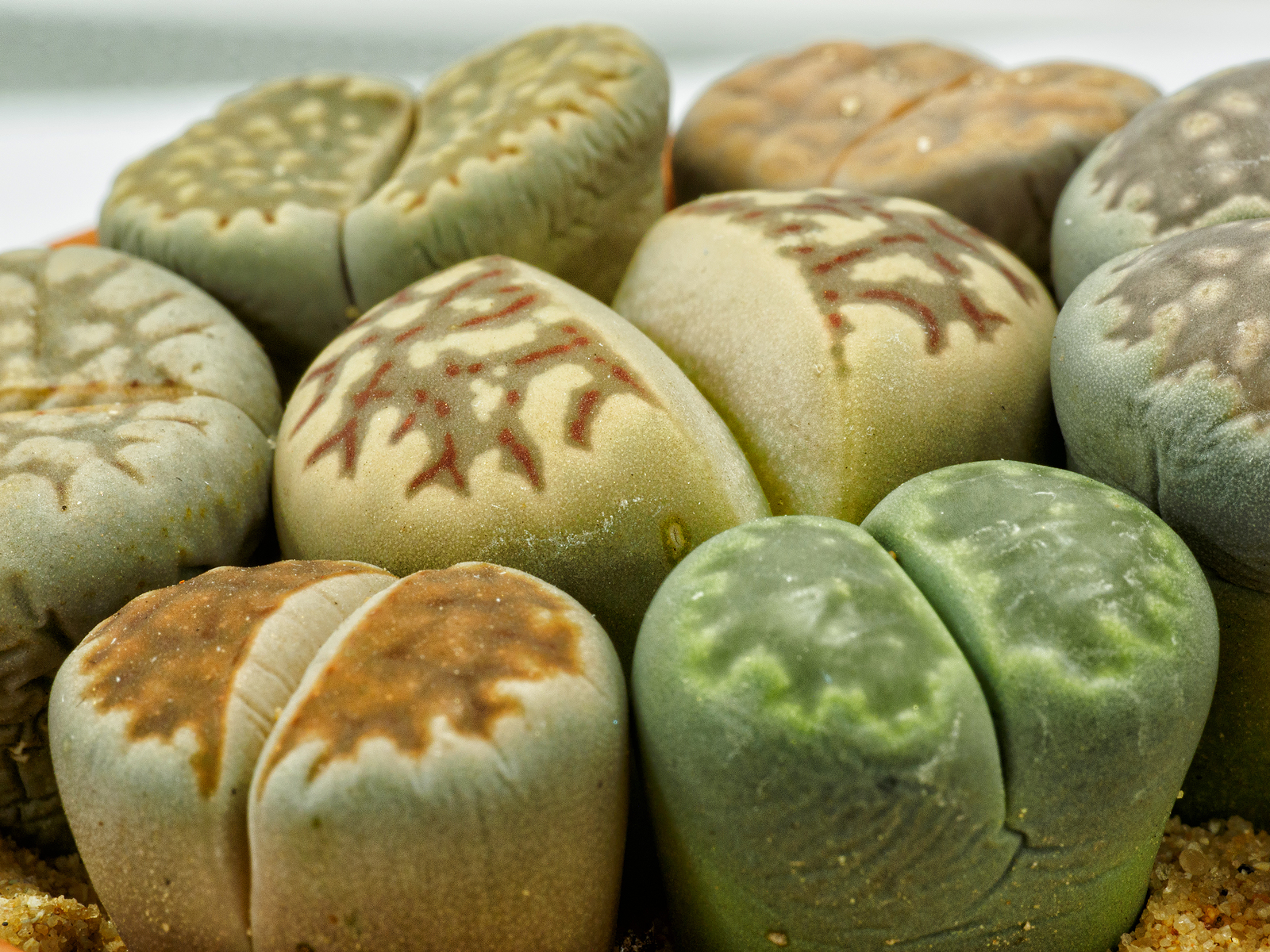
Lithops–commonly called stoneface or living stones–are dwarf, almost stemless perennial succulents that are easily mistaken for small stones. There are several species of Lithops; at least six are commonly sold in garden centers.
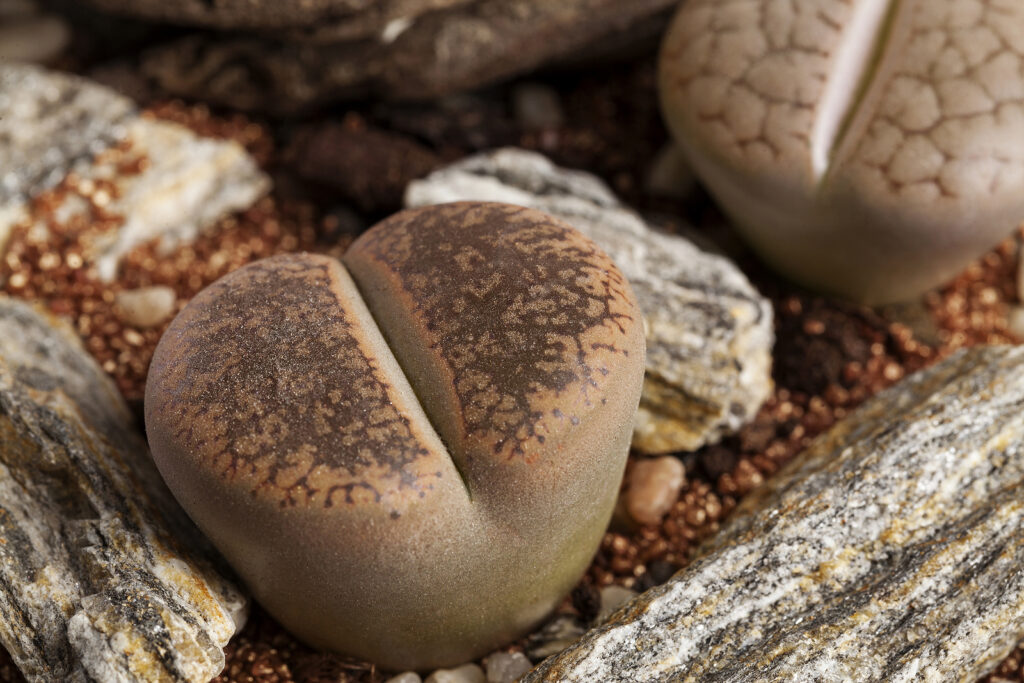
Lithops are commonly shaped like an inverted, flattened cone. Each plant consists of a pair of extremely thickened leaves that are fused together to produce a stem-like body with a slit at the top. The split or fissure across the middle of the nearly flattened top may appear as a tiny hole or as a slit that extends to the base of the plant. Below ground, there is a short stem and a long tap root.
From this fissure atop Lithops emerge new leaves and the large, daisylike flower that can be yellow or white. Lithops usually blooms from late summer to early winter. Flowers appear in the afternoon, then close at night. In some case, the color of the leaves is affected by the soil type the plants grows in.
Lithops grows during the winter and are dormant during early and mid-summer. As a houseplant, they grow best in a well-lighted location. They are unusual and fascinating indoor plants, especially when blooming.
Know What to Plant This Week
Every week I answer the gardener's most important question: what should I plant now? Get seasonal planting advice free — or go Pro for my full Soil Temperature Garden Report, with soil temperature, moisture, weather trends, and crop-by-crop recommendations.
Lithops is a genus of 40 species native to dry, rocky regions of South Africa. Nearly all belong to two genera, Lithops and Conophytum.
Get to know Lithops
- Plant type: Succulent evergreen perennials
- Hardiness temperature: 30℉ (-1.1℃)
- Optimal growing temperature: day, 65° to 80°F (18° to 127°C); night, 50° to 70°F (10° to 121°C).
- Shape and size: Tiny rounded leaves look like columns with mosaic markings of brown, pink, and gold; they grow 1 to 2 inches (2.5-5cm) tall and wide
- Flowers: Daisylike bloom may appear on two leaves; flowers, usually yellow or white, appear in the afternoon, then close at night.
- Bloom time: Late summer
- Common name: Living stones, stoneface
- Genus name: Lithops
- Family name: Aizoaceae
- Origin: South Africa
Planting Lithops
- Plant Lithops in a well-lighted location.
- Indoors plant Lithops in bright light from a southern or western exposure. Lithops does well under artificial light. It needs 16 light hours each day. Air circulation is important.
- Plant Lithops in a cactus-succulent mix.
How to water and feed Lithops
- Water Lithops lightly until the soil is just moist; let the soil dry between waterings. Avoid overwatering.
- Stop watering completely after bloom until two new leaves appear.
- Do not water Lithops during its summer rest period.
- Lithops prefers humidity of 20 to 25 percent.
Lithops care
- Lithops is a slower grower and will not need repotting.
- Check Lithops for mealybugs, root rot, and scale.
- Lithops grows during the winter and rests in summer; place it in a well-ventilated, not-too-bright location to rest.
Growing Lithops as a houseplant
- Give Lithops direct light, an average temperature, and low humidity.
- Water Lithops infrequently and let the soil dry out between waterings; overwatering causes roots and stems to rot.
Lithops pests and diseases
- Lithops can be damaged by mealybugs and scale insects.
Lithops propagation
- Propagate Lithops by division. Separate offsets and pot them in a cactus mix.
Lithops species to grow
- Lithops dinteri. Clustering plant with pairs of reddish or grayish-yellow leaves; inversely cone-shaped body with a convex upper surface; bears yellow flowers.
- L. karasmontana. Clump-forming with pairs of pale red-brown leaves that form an inverse cone; dark brown markings and wrinkles on the upper surface; bears white flowers in late summer.
- L. pseudotruncatella. About 1 inch tall with a pair of brownish gray leaves that form an inverse cone; dotted with brownish green; bears golden yellow flowers in late summer.
- Other Lithoops species include L. fulleri with a grey-green mottled top, L. salicola which is gray with a green mottled top, L. optical which is gray-green with translucent ‘windows’ on the upper surface, L. lesliei which is brown with lighter markings, L. bella which is pale brown with dark markings. All are 1 to 1.5 inches tall.
- Members of the Conophytum genera include C. bilobum which is grey-green tinged with red, C. calculus which is pale green, and C. friedrichae which is green with a translucent top.
Lithops frequently asked questions
Q: How should living stones be treated?
A: Plant living stones (Lithops) close together in a shallow pan filled with exceedingly porous soil. The tops of the plant should be well above the soil level. Water living stones regularly from late autumn until mid-spring. Keep the plants dry at other times. They should be fertilized only rarely. Shade living stones from the bright summer sun and give them good air circulation. They need a cool winter temperature of 50° to 60°F.
Q: What is the best soil for growing living stones?
A: Lithops need a well-draining soil mixture of half sand and half all-purpose potting soil with a pinch of bone meal added. A top dressing of gravel or pebbles is helpful. It is important to prevent rot by keeping the leaves above the soil even though Lithops leaves often grow below ground in their natural habitat.