🌿 Container Garden Fertilizer Schedule (When and How to Feed for Strong Growth)

🌱 Why feeding matters more in containers
If your container vegetables start strong but fade halfway through the season, the issue is often not sunlight or watering—it’s nutrition.
In the ground, plants can reach deeper for nutrients. In containers, they depend entirely on what you provide. Every time you water, a small amount of fertility washes away. Over time, that loss adds up.
From my experience growing vegetables year-round in raised beds and containers in Sonoma Valley, feeding isn’t about adding more fertilizer—it’s about maintaining a steady supply. When nutrients stay consistent, plants grow steadily, recover faster, and produce more reliably.
🪴 Quick answer: how to fertilize container vegetables
A simple, effective feeding system looks like this:
Know What to Plant This Week
Every week I answer the gardener's most important question: what should I plant now? Get seasonal planting advice free — or go Pro for my full Soil Temperature Garden Report, with soil temperature, moisture, weather trends, and crop-by-crop recommendations.
- mix in a slow-release fertilizer at planting
- begin liquid feeding once plants start active growth
- continue feeding regularly through the growing season
The key is consistency, not intensity. Sudden heavy feeding often creates more problems than it solves.
(If your plants are already struggling, it’s worth first checking your soil structure in Best Potting Soil Mix for Container Vegetables, since poor soil can limit nutrient uptake no matter how much you feed.)
🌿 1. Start with slow-release fertilizer at planting
A strong container garden begins before the plant goes in.
Slow-release fertilizers provide a steady baseline of nutrients that support early root development and balanced growth. Without that base, plants often rely too heavily on liquid feeding later, which can lead to uneven growth.
In my own planting routine, I always incorporate a balanced organic fertilizer into the mix before planting. It creates a buffer that helps young plants establish quickly.
This step is especially important for long-season crops like tomatoes, peppers, and eggplant, which will need sustained nutrition over time.
💧 2. Add liquid feeding as plants begin active growth
Once plants are established and growing steadily, their nutrient needs increase.
This is when liquid feeding becomes important. Unlike slow-release fertilizers, liquid feeds are immediately available to plants and can support rapid growth and fruit development.
In practice, I begin liquid feeding once I see consistent new growth—usually a couple of weeks after planting. From there, I maintain a regular schedule rather than waiting for signs of deficiency.
(If you’re unsure how watering affects nutrient delivery, see How Often to Water Container Vegetables. Water and feeding always work together.)
📅 3. Keep feeding consistent through the season
Inconsistent feeding is one of the most common causes of poor performance in container gardens.
Plants respond best to a steady supply of nutrients. If feeding is irregular, growth tends to stall and restart, which leads to stress, uneven development, and reduced yields.
Over the years, I’ve found that light, regular feeding produces better results than occasional heavy applications. It keeps plants in balance and avoids the extremes that can cause problems.
🍅 4. Adjust feeding for leafy vs fruiting crops
Not all crops need the same nutrients at the same time.
- Leafy crops (lettuce, spinach, kale) benefit from steady nitrogen to support continuous leaf production
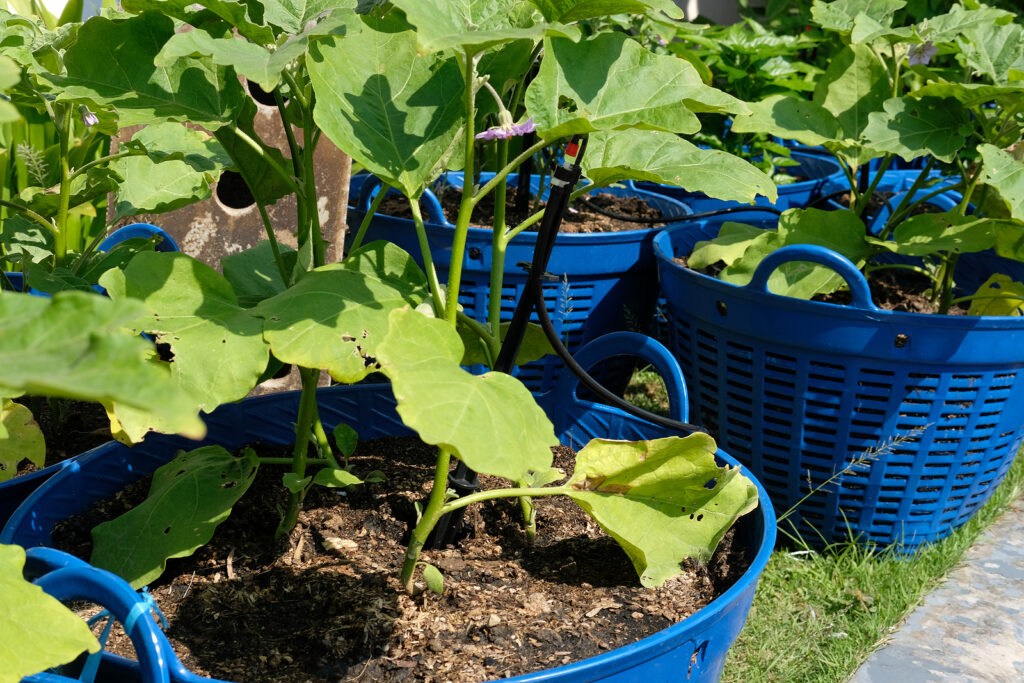
- Fruiting crops (tomatoes, peppers, cucumbers) need more phosphorus and potassium as they begin to flower and set fruit
One mistake I see often is continuing high-nitrogen feeding on fruiting crops. This produces lush green growth but fewer fruits.
In my garden, I shift feeding slightly once flowering begins—maintaining balance but supporting fruit development more directly.
🌡️ 5. Watch for nutrient loss in warm weather
As temperatures rise, containers dry out faster—and nutrients are lost more quickly through frequent watering.
This means feeding needs often increase in mid- to late-season, even if your routine hasn’t changed. Plants that were thriving earlier can begin to fade simply because nutrients aren’t being replaced fast enough.
This is where consistency becomes critical. When watering frequency increases, feeding needs to keep pace.
🧱 6. Recognize signs of nutrient imbalance early
Most fertilizer problems show up gradually.
Common signs include:
- yellowing leaves (often nitrogen deficiency)
- slow growth or small leaves
- poor flowering or fruit set
- pale or uneven color
In my experience, these symptoms are often mistaken for watering issues. While water and nutrients are closely connected, correcting feeding usually resolves the problem more effectively.
(If you’re seeing multiple symptoms at once, it’s often helpful to revisit Why Container Vegetables Fail to identify the underlying cause.)
🪴 7. Avoid overfertilizing
More fertilizer does not mean better results.
Excess nutrients can lead to:
- salt buildup in the soil
- root stress or damage
- excessive leafy growth with little fruit
In containers, where there’s no natural system to buffer excess, it’s easy to overdo it. That’s why a steady, moderate approach works best.
I’ve found that plants perform better when nutrients are available in balance rather than in large doses.
🔧 Troubleshooting: problem → cause → adjustment
When plants underperform, simplify the diagnosis:
- Yellowing leaves → low nutrients → increase feeding consistency
- Lush growth, few fruits → too much nitrogen → rebalance fertilizer
- Slow growth → depleted soil → combine feeding with soil refresh
- Burned leaf edges → excess salts → reduce feeding and flush soil
These patterns repeat across crops and seasons, which makes them easier to recognize over time.
🌿 Advanced observations from experience
After years of growing in containers, a few things stand out:
- feeding works best as part of a system, not a separate task
- soil, water, and nutrients must stay in balance
- plants respond more to consistency than to correction
In other words, it’s not about reacting to problems—it’s about preventing them through steady care.
❓ FAQ
Do I need both slow-release and liquid fertilizer?
Yes—one provides a steady base, the other supports active growth.
How often should I fertilize?
Light, regular feeding is more effective than occasional heavy feeding.
Can I skip feeding if I use good soil?
No—container soil cannot replenish nutrients on its own.
What’s the biggest feeding mistake?
Inconsistency—plants struggle when nutrients fluctuate.
🌱 What to do next
If your container plants are growing but not thriving, feeding is one of the easiest systems to improve.
Start by building a steady foundation:
- add slow-release fertilizer at planting
- begin consistent liquid feeding early
- adjust as plants grow and conditions change
In my experience, once feeding becomes consistent, plants stabilize—and production follows.
From here, the next step is to make sure your soil mix supports nutrient retention and your watering routine keeps everything in balance. When those three systems work together, container gardening becomes far more predictable—and far more productive.
Before planting, review Container Sizes for Growing Vegetables and Calculating Soil Requirements for Different Container Sizes to avoid common setup mistakes.