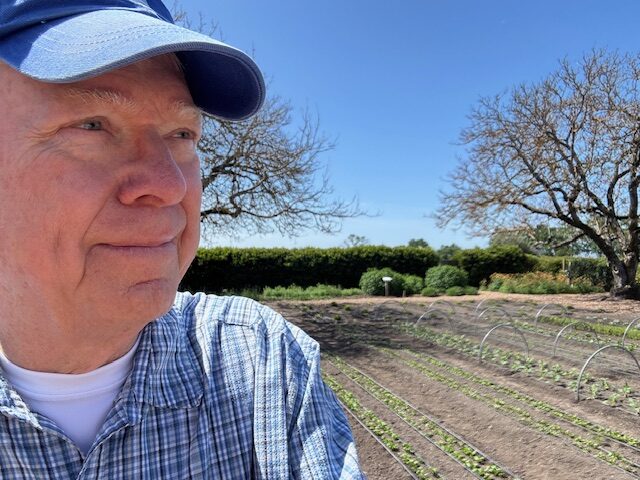
Stephen Albert is a horticulturist, master gardener, University of California instructor, and certified nurseryman. Stephen taught in the landscape design program at the extension college of the University of California at Berkeley for nearly three decades. He served as a director and president of the master gardeners of Sonoma County, Unversity of California, Davis. He holds graduate degrees from the University of California, Berkeley and the University of Iowa. He is now the vegetable garden lead at the Sonoma Garden Park in Sonoma, California. You can find him there four days a week year-round tending more than 30 in-ground and raised vegetable and herb beds using regenerative, no-till garden practices. His four practical gardening books are The Kitchen Garden Grower’s Guide, Vegetable Garden Almanac & Planner, Tomato Grower’s Answer Book, and The Vegetable Garden Grower’s Guide. His online course for gardeners is the Vegetable Garden Growers’ Masterclass. His YouTube channel is Harvest to Table videos.
A Note From Stephen:
“Thanks for visiting my website. I’m Stephen Albert, a lifelong gardener, horticulturist, master gardener, certified nurseryman, and gardening educator. My journey began in California’s Central Valley, where I grew up gardening alongside my parents. Over the years, I’ve had gardens in Massachusetts, Iowa, and Southern Florida. Today, I garden year-round in Sonoma Valley, Northern California where I grow vegetables in raised beds, mounded beds, and containers—whatever it takes to keep the harvest going.
For nearly 30 years, I taught in the landscape design program at the University of California, Berkeley Extension and served as director and president of the Master Gardeners of Sonoma County through UC Davis. I earned graduate degrees from the University of California, Berkeley and the University of Iowa, but my deepest horticultural and garden education has come from decades spent growing and observing in the garden. Over the years I have had the privilege to garden alongside folks of all ages from children, to young adults, to mid-lifer, and seniors. I’ve found that I never stop learning in the garden.
My gardening philosophy draws on both tradition and practicality. Imagine you could gather the wisdom of all the great vegetable gardeners through history—Thomas Jefferson, the French master Jean-Baptiste de La Quintinie, the gardeners of the ancient Mayan, Incan, and Shang cultures—and apply that knowledge in your own backyard. I have and you can! I have learned something from them all — and I love to pass on to others the great gardenings traditions.
I call my vegetable gardening apporach the NEW garden—an approach that blends the best of the past with the needs of modern gardeners. NEW stands for Narrow bed, Equidistant planting in Wide rows. It’s a method Jefferson used at Monticello and La Quintinie practiced at Vaux-le-Vicomte; it’s a way of gardening that ancient Chinese gardeners practiced as well. I’ve grown NEW gardens large and small for more than 30 years across the country. I’ve consistently found NEW gardens produce three times more food with one-third less effort than traditional row gardens. (You can read about the NEW garden approach in my book The Vegetable Garden Grower’s Guide.)
Whether your space is a backyard plot, community garden, or even a balcony with a few pots, the NEW method can work for you. I share this practical, time-tested approach here at Harvesttotable.com and through my books—The Kitchen Garden Grower’s Guide, Vegetable Garden Almanac & Planner, Tomato Grower’s Answer Book, and The Vegetable Garden Grower’s Guide—and through my online course, The Vegetable Garden Growers’ Masterclass. I also share my years of experience on the Harvest to Table videos channel on YouTube.
Thanks so much for stopping by my website and visiting my YouTube channel! I’m glad you’re here. Whether you’re just getting started or you’ve been gardening for years, I hope you find inspiration, practical tips, and time-tested techniques to help you grow a more abundant and enjoyable vegetable garden. Your interest and support mean a lot, and I’m excited to keep sharing what I’ve learned over a lifetime in the garden. Happy growing—and come back soon!”