The Ultimate Asparagus Growing Guide: From Seed to Harvest

Asparagus is a long-lived perennial vegetable that requires three to four years to become established and productive. Once established, an asparagus plant can produce spears for 15 to 20 years or more. It is best to grow asparagus in dedicated planting beds–often referred to as the “asparagus patch”.
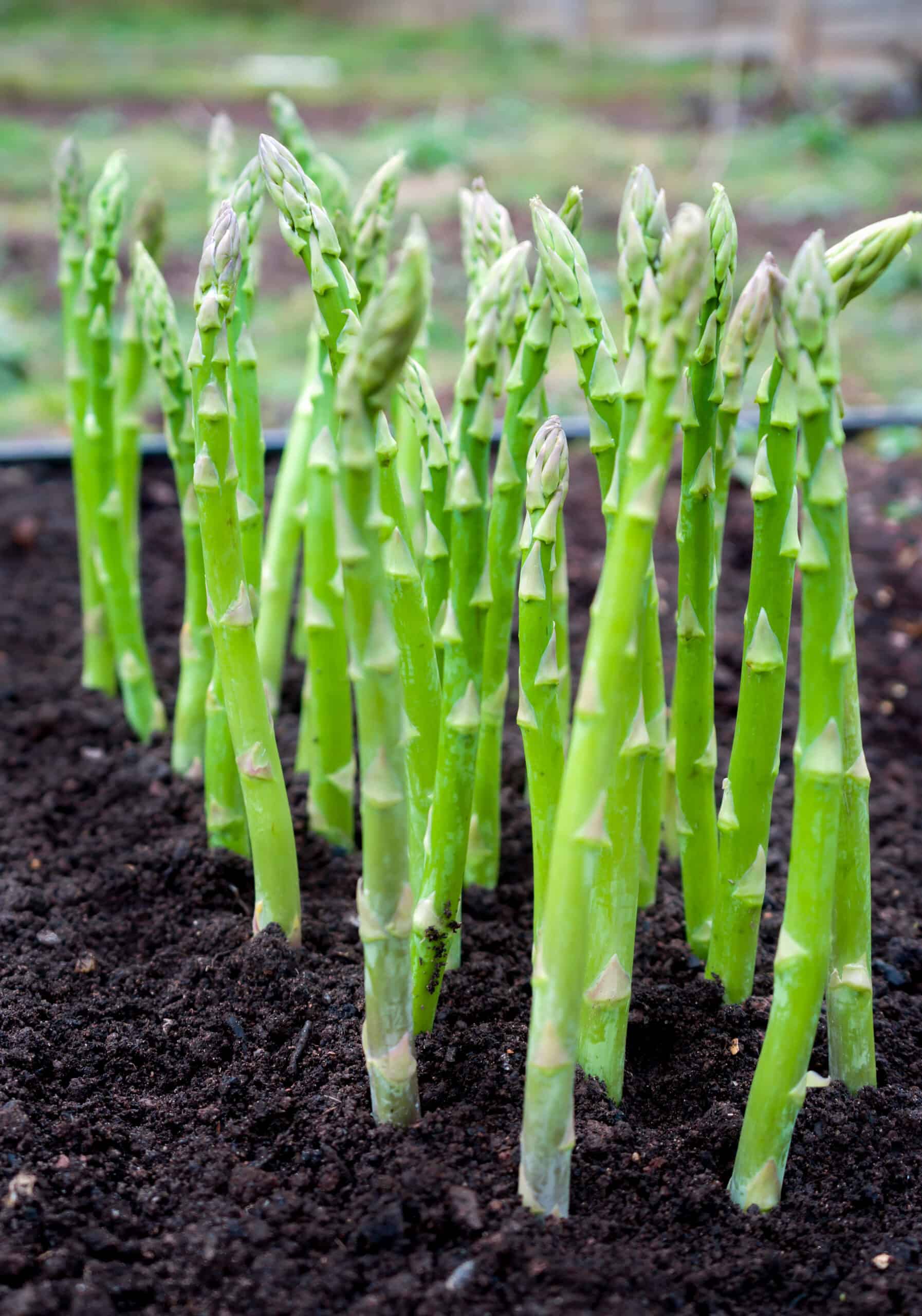
Asparagus grows from fleshy roots called crowns. The plant produces fernlike, feathery foliage that can grow to 3 or more feet tall. The part eaten and appreciated by gourmets is the tender young stem.
The appearance of asparagus is the first sign of Spring in many vegetable gardens.
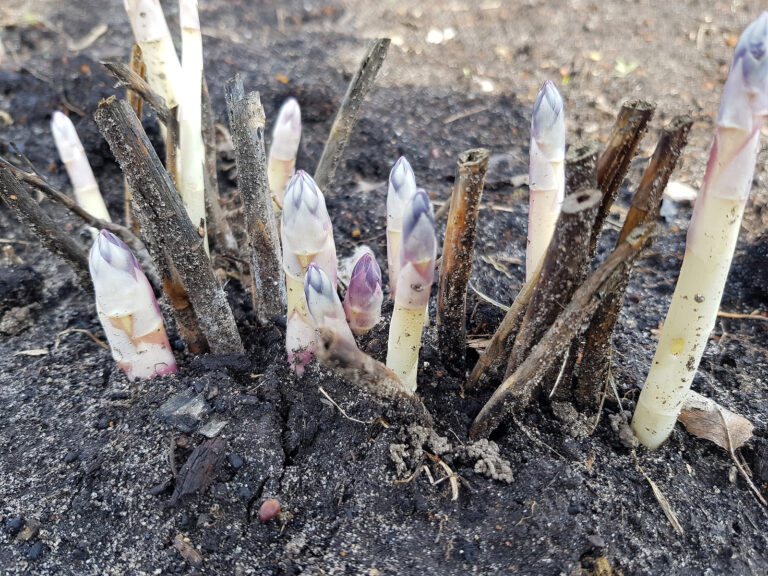
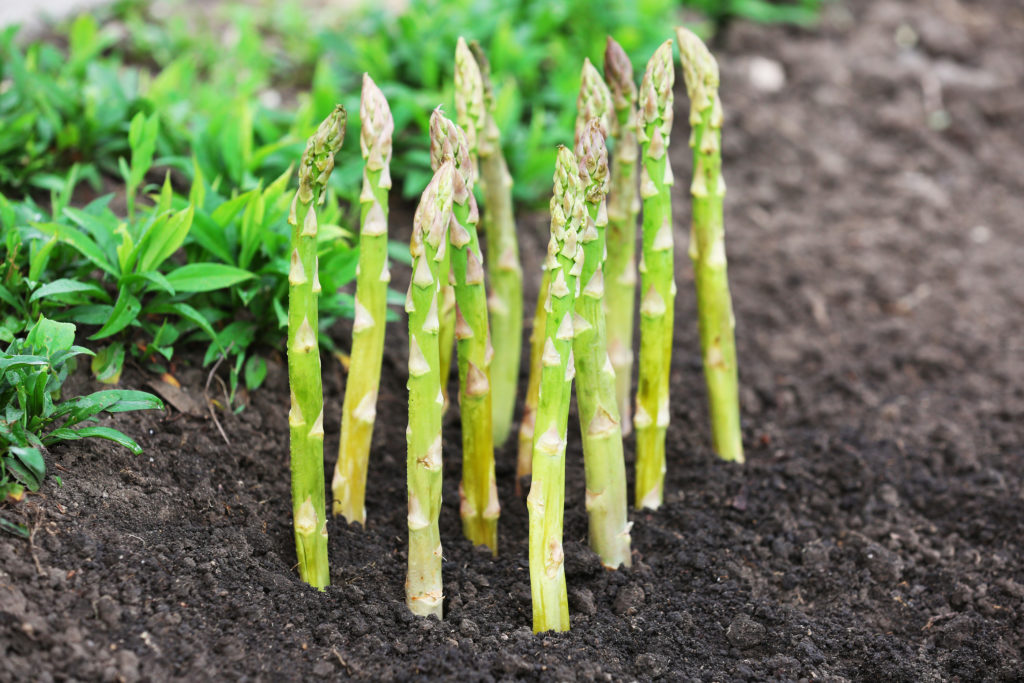
Stalks or spears begin to break the soil in early spring as soon as the soil temperature reaches 50°F (10°C).
Related articles:
- Seven Ways to Cook and Serve Asparagus
- Asparagus Growing Problems Troubleshooting
- How to Plant Asparagus
- How to Grow Asparagus
- How to Harvest and Store Asparagus
- Canning Asparagus
- How to Cook Asparagus with No Recipe
- Asparagus Beetle Organic Pest Control
Sowing asparagus seed and planting crowns (roots)
If you grow asparagus from seed, your first harvest will come in three years. If you grow asparagus from crowns (established roots), the first harvest will come a year after planting two-year-old crowns and two years after planting one-year-old crowns. Crowns are available in nurseries and garden centers each spring or you can start your own. To start plants from seed, sow seeds indoors or outdoors in early spring one year before re-setting the roots in their permanent location.
Asparagus can be eaten raw, parboiled, steamed, boiled, baked, roasted, and grilled.
Here is your complete guide to growing asparagus!
Asparagus planting time
- You can grow asparagus from seeds, crowns (roots), or transplants.
- Start seed indoors 12 to 14 weeks before the last frost.
- Transplant seedlings or plants into the garden after the last frost.
- Plant asparagus seeds or crowns in the garden in early spring as soon as the soil is workable. The soil temperature should be 50°F (10°C) or warmer.
- Allow asparagus 3 years to establish its roots before you begin harvesting.
Selecting asparagus plants
- Choose an asparagus cultivar adapted to your region; check at a nearby garden center for recommended varieties for your area.
- Asparagus will grow in almost all regions of North America except for Florida and the Gulf Coast where the weather is usually too wet and too mild.
- U.C. 157 and ‘Apollo’ grows well on the West Coast and mild winter regions.
- In USDA Zones 4 to 6, in the East and Midwest, plant varieties such as ‘Jersey Giant’, ‘Jersey King’, and ‘Jersey Knight’. These are male varieties that are the most productive. Heirloom varieties including ‘Mary Washington’ and ‘Martha Washington’ can also be planted but they produce female plants which are not as productive as male plants. In the coldest regions plant ‘Guelph Millennium.
- All-male cultivars offer the highest yields.
Where to grow asparagus
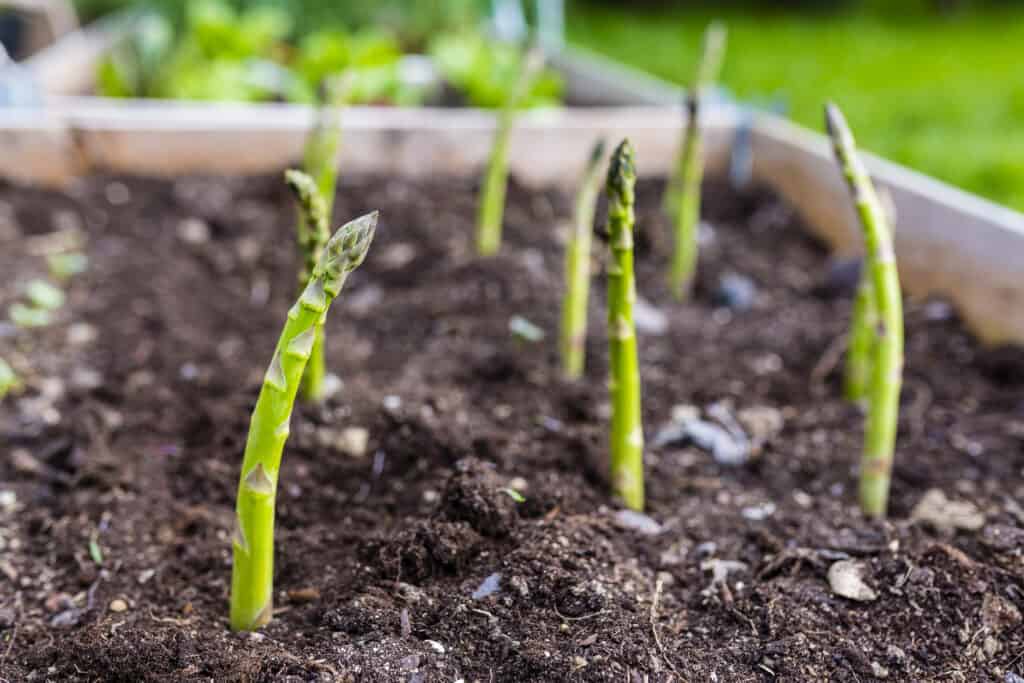
Grow asparagus in deep, loose, well-drained soil rich in organic matter and compost. Choose a location that gets at least 6 hours of sun each day.
- Asparagus is a perennial. Plant asparagus in a spot or perennial bed where plants can grow undisturbed and productive for 15 to 20 years. Many growers establish a dedicated “asparagus patch” for growing this perennial crop.
- Plant asparagus in full sun where it gets plenty of air circulation; this will help prevent disease. Asparagus can tolerate partial shade.
- Choose a planting site protected from strong winds, which can break the fern-like plants.
- Plant asparagus out of prevailing winds; wind can damage or break stalks.
- Asparagus grows best in loose, compost-rich well-drained soil. Sandy loam is good soil for growing asparagus.
- Add 3 to 4 inches (7-10cm) of aged compost and decomposed organic matter across the soil surface of the planting bed and turn it under to 12 inches (30cm) deep or more before planting asparagus.
- Plant in raised beds if your native soil is poor or constantly wet. Good drainage is essential for asparagus success.
- Planting asparagus where a cover crop that adds lots of organic matter to the soil can result in a greater harvest.
- A soil pH between 6.5 and 7.5 is best for growing asparagus.
Starting asparagus from seed indoors
- Asparagus plants grown from seed are less susceptible to transplant shock than those started from crowns. Also, an asparagus plant started from a seed will be more productive over the course of its life than a plant started from a crown.
- Sow seed 8 to 10 weeks before you plan to set transplants in the garden.
- Soak seeds in compost tea for 5 to 10 minutes before planting; this will help reduce disease problems.
- Sow seed 1 inch (2.5 cm) deep in a seed-starting mix or light potting soil. Sow seeds in individual containers.
- Seeds will germinate in 7 to 21 days at 75°F (24°C).
- Place seedlings in a cold frame, plastic tunnel, or greenhouse to grow on until outdoor temperatures are warm enough for transplanting. The optimal growing temperature is 60° to 70°F (15-21°C).
- After the seeds sprout, lower the temperature to 60° to 70°F.
Male and female asparagus plants
- Male asparagus plants produce more spears than female plants. You can cull out female plants by looking at the flowers.
- Female flowers have three-lobed pistils; male flowers are larger and longer than female flowers.
- Female plants produce fewer spears than male plants; cull out female plants for the best yield.
Starting asparagus from seed outdoors
To start plants from seed, sow seeds indoors or outdoors in early spring one year before re-setting the roots in their permanent location. Cover the seed with ½”(12 mm) of soil. The seeds will germinate in 14-18 days at 75°F (25°C).
- Start asparagus outdoors in early spring from seed in a protected nursery bed or under a portable plastic tunnel or cold frame.
- Sow 2 seeds per inch (2.5cm); space rows 18 inches (45cm) apart.
- When seedlings are 3 inches (7.6cm) tall, thin plants to 4 inches (10cm) apart.
- At the end of the summer, transplant male plants to a permanent spot. You can keep female plants to grow on, but they will produce fewer spears than male plants.
Growing asparagus from crowns
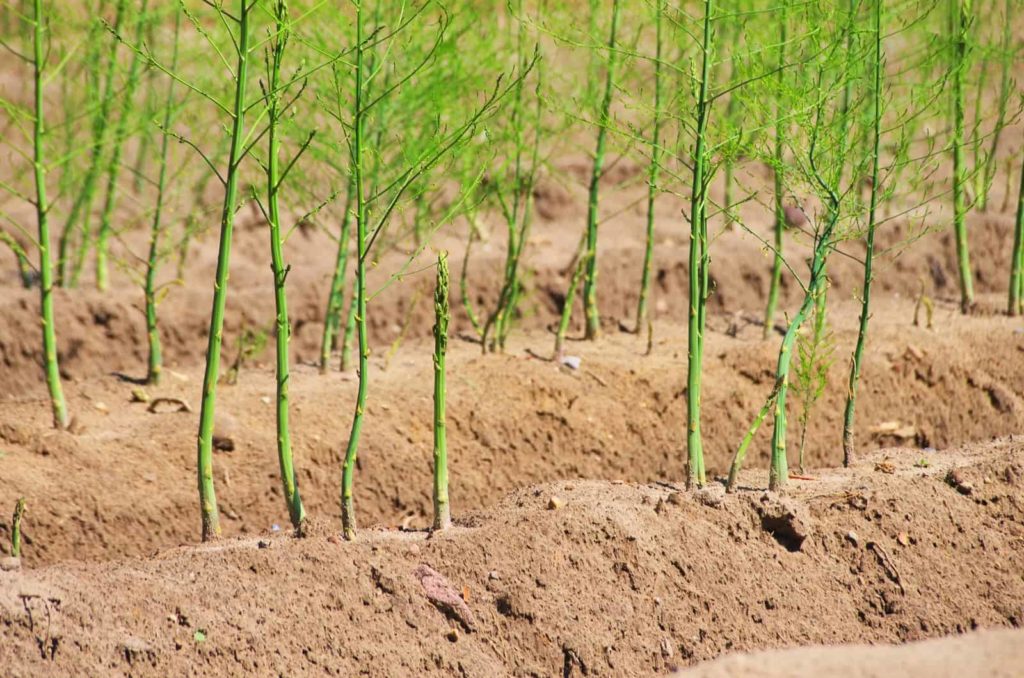
Set asparagus crowns (roots) in the garden as early as the soil can be worked in spring. Set one- or two-year-old crowns in trenches 6 to 8 inches (15-20 cm) deep and in rows 12 to 18 inches (30-45 cm) apart. Space roots 8 inches (20 cm) apart for slender spears to 14” (36 cm) apart for thick spears.
- Asparagus can be grown from roots (called crowns). Crowns are sold at garden centers in late winter and spring and online by seed companies. Crowns are the roots of plants started by a seed grower.
- You can purchase one, two, or three-year-old crowns. One-year-old crowns are less susceptible to transplant shock.
- A viable crown will be fresh, firm, and healthy-looking. Avoid crowns that look dry or shriveled.
- Store crowns until planting time in slightly moist leaf mold or aged compost.
Growing asparagus from seedlings
Seed-started asparagus seedlings sold in six-packs can be planted in early spring once the soil is workable and daytime temperatures stay above 50°F. Choose a sunny, well-drained bed enriched with compost. Space seedlings 12 to 18 inches apart in rows 3 to 4 feet apart to allow for mature root spread and easy care. Plant them at the same depth they were growing in the pack—usually about 2 to 3 inches deep—gently loosening any bound roots before setting them in. Water well and keep the soil evenly moist as they establish strong crowns for future harvests.
Planting asparagus crowns outdoors
- Asparagus crowns can be planted in the garden in early spring as soon as the soil can be worked and the soil temperature has warmed to at least 50°F. Air temperatures below 40°F as well as frost and freezes can kill the growing tips of young plants. (Many gardeners plant asparagus and potatoes at the same time in spring.)
- Before planting soak crowns for 10 to 15 minutes in compost tea.
- Plant crowns in beds already prepared with aged compost or commercial organic planting mix.
- Dig a trench 6 to 8 inches (15-20cm) deep and 12 inches (30cm) wide. Space trenches 3 to 4 feet (.9-1.2m) apart.
- Create a 2-inch-high (5cm) furrow or mound down the center of the trench.
- Set crowns atop the mound; drape the crown’s spider-like roots over the edges of the mound. Set crowns 18 to 24 inches (45-61cm) apart.
- Cover crowns with 2 inches of soil. Spears will begin to grow in a few weeks.
- As the spears grow from the crown, cover them again with 2 inches (5cm) of soil. Repeat this process until you gradually fill in the trench. Do not bury the spears completely as you fill in the soil.
- Continue to mound up soil over the spears as they grow up so that plants are growing on 4-inch (10cm) tall or higher ridges or rows.
- Plant between 30 and 40 plants for each person in the household.
More tips at Asparagus Growing.
More tips on starting asparagus plants: Asparagus Plant Starting Tips.
Asparagus companion plants
- Plant basil and parsley near asparagus; both repel asparagus beetles.
- Spinach, lettuce, and other leafy crops can be grown in the shadow of asparagus ferns.
- Avoid plants asparagus with other members of the onion family such as garlic, onions, and shallots. They attract the same insect pests.
Watering asparagus
Keep the soil evenly moist throughout the growing season; do not water during the winter.
- Keep asparagus planting beds evenly moist but not wet throughout the growing season.
- Give asparagus plants an inch of water each week in summer; 1 inch equals 16 gallons or 60.5 liters.
- Mature plants can survive without extra watering, but the stalks may become stringy and woody.
- Water at the base of plants or use drip irrigation. Avoid overhead watering which can leave plants susceptible to fungal diseases.
Feeding asparagus
- Add two inches of aged compost to planting beds every spring or sprinkle a high phosphorus and potassium slow-release granular fertilizer, such as a 5-10-10 organic fertilizer, down rows before spears appear in spring.
- Move mulch aside when fertilizing asparagus in spring.
- Feed asparagus as above again at the end of the harvest.
Caring for asparagus
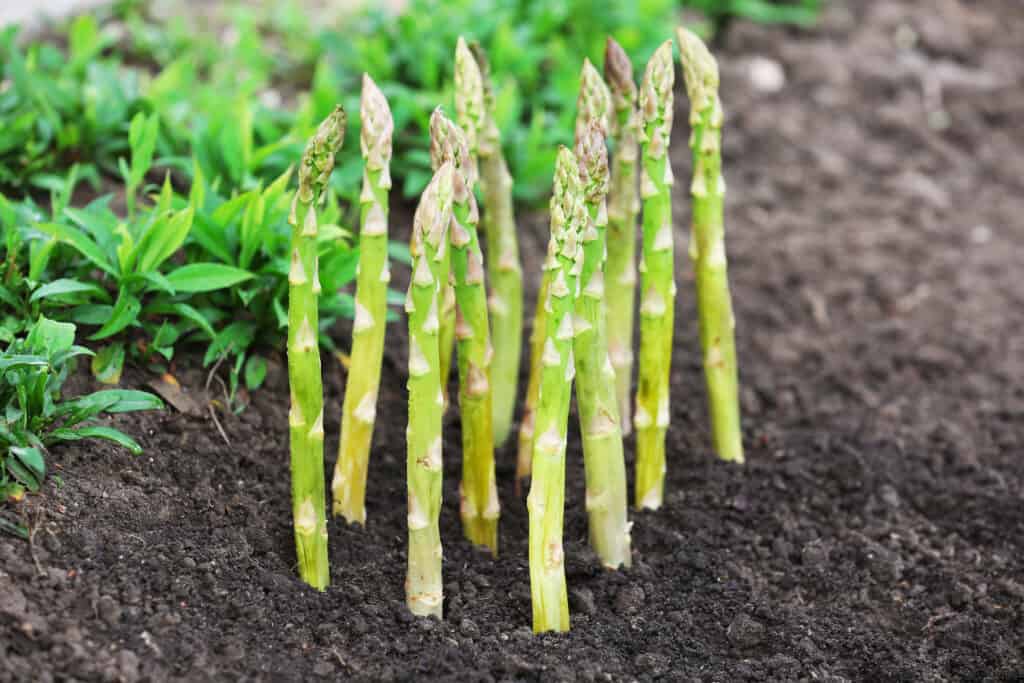
- Mound 1 to 2 inches (2.5-5cm) of aged compost or commercial organic planting mix over established crowns every spring. Aged compost has all the nutrients asparagus plants need. Plants will easily grow up through the added soil.
- Keep asparagus beds well-weeded. Competition from perennial weeds with deep roots will lower the yield. Weed control by hand weeding is much better than using an herbicide.
- The growth of annual weeds during the warm months of the year can be stifled by applying a mulch of grass clipping–which will also add nitrogen to the soil.
- Planting through black plastic atop raised rows will keep down weeds.
- To grow white asparagus spears, blanch the shoots by mounding soil up around the spears as they grow. (White asparagus is not a variety. Blanching spars by mounding soil up around the spears prevents sunlight from reaching the spears and keep chlorophyll from developing.)
- Erect windbreaks if there is a prevailing breeze; blowing soil can damage spears.
- Mulch asparagus plants with straw or leaf mold during the winter to protect roots from freezing temperatures.
- When plants become dry and brittle in late fall, cut plants back to 1 inch above the soil. Add aged compost or commercial organic planting mix over plants.
- If a frost or freeze is forecast, protect spears and crowns by covering them with several inches of straw or chopped leaves or with row covers. Unprotected spears hit by a freeze will turn brown, wither, and become soft or they may die.
Blanching asparagus
- White asparagus–which is preferred by many for its mild flavor–is not a variety of asparagus; it is blanched. The spears are covered so that sunlight does not make chlorophyll which turns the spears green.
- To blanch asparagus, mound soil up around the plant so that sunlight is blocked. Check the spears every day or two as they grow to harvestable size.
Transplanting asparagus
- Established asparagus crowns can be lifted and replanted elsewhere.
- Transplant crowns in early spring while they are still dormant or in late fall before after the foliage has turned brown and been cut back.
- Dig and lift the crown with a spading fork being careful not to damage the roots.
- Divide the clump into two or more pieces.
- Soak the crowns in water for an hour or two before replanting.
Companion plants for asparagus
- Plant tomatoes, parsley, and basil near asparagus. Avoid planting root vegetables near asparagus.
Asparagus pests
- Cutworms and armyworm feed on young spears just below the soil line; sometimes they can be seen on the soil. Plants will wilt and young spears will fall over when they are “cut” or eaten by these pests. Control these pests with diatomaceous earth or beneficial nematodes or hand-pick them out of the soil and destroy them.
- Slugs and snails will chew on young spears; handpick them or trap them in a tin of beer placed at soil level; the yeast in the beer will attract them and they will drown.
- Asparagus beetles may attack asparagus, especially in commercial asparagus growing districts. Spears will turn brown and bend in a hook shape when asparagus beetles feed on them. There are two types of asparagus beetle–one with a metallic blue or dark green with white spots back and the second with black spots over an orange back. Remove and crush the beetles by hand. Look for eggs and crush the eggs in the fall.
- Asparagus beetles and larvae chew spears in spring and feed on fronds in summer.
- Asparagus miners are the larvae of black flies. The larvae will eat strips along the sides of shoots. Exclude flies with floating row covers.
- Aphids and thrips can attack asparagus leaves and stems. Use neem oil to destroy these sap-sucking pests.
- Protect new beds with row covers. Pick off and destroy asparagus beetles or spray with insecticidal soap or pyrethrins.
Asparagus diseases
- Asparagus is generally disease-free.
- Fungal diseases such as asparagus rust and fusarium wilt can attack asparagus. Spray-mist plants with compost tea to prevent fungal diseases.
- Treat seed to prevent disease before planting; soak the seed in a one-part bleach to nine parts water solution for two minutes then rinse the seed.
- Plant disease-resistant cultivars.
- Asparagus rust appears first as pale green spots on the emerging spears; the spots become yellow-orange concentric gings and reddish-brown blisters appear in summer; defoliation of the plant follows. Destroy infected plants. Plant rust-resistant varieties. Ensure good air circulation.
- Crown rot (Fusarium crown rot) and root rot can occur if the soil stays wet. Plants become yellow, stunted, and ferny tops wilt; reddish-brown spots appear on the lower stems, and roots and stems can rot. Be sure the soil is well drained, and avoid overhead watering; wet ferns are susceptible to fungal diseases. Destroy infected plants. Choose resistant varieties.
- Fusarium root rot causes plants to blacken and collapse. Remove infected plants; there is no treatment. Plant resistant varieties in new beds. Do not replant in infected beds for at least 3 years.
- Stemphylium purple spot is a fungal disease that causes purple spotting on foliage and stems. Use an organic fungicide to stem the spread.
More about asparagus pests and diseases: Asparagus Growing Problem Troubleshooting.
How to protect asparagus from the winter cold
Protect perennial asparagus plants from cold temperature damage by mulching the asparagus bed with compost, aged manure, or straw before freezing weather or snow arrives.
Asparagus crowns can produce tasty spears for 20 years or longer if given the right care and nutrients.
The ferny stalks and branching growth of asparagus plants capture energy through photosynthesis during the growing season strengthening asparagus crowns (the collection of fleshy roots just below the soil surface) for spear production the following year.
Leave asparagus stems on plants as long as they remain green—well into autumn. When stalks turn brown and brittle cut them off at ground level and top dress the bed with compost or manure. (Place cut stalks and ferns in the trash—not in the compost pile; asparagus-beetle eggs can overwinter in cut stalks.)
Again, cutting stalks back too soon means sacrificing photosynthesis and will mean less spear production next year. The exception: cut down female asparagus plants before they set seed (red berries); seed production diverts energy from crowns and lowers future yield. (Picking off berries is a solution, but highly time-consuming. Growing only male plants may be the best course—as well as the source of thicker spears.)
Where heavy snow covers asparagus beds in the winter let stalks turn brown and fall across the planting bed to form their own mulch to protect plant crowns. Then add 6 inches of straw, pine needles, or well-rotted or chopped leaves to the top of fallen stalks to give crowns extra protection from freezing temperatures.
A planting bed of well-drained garden loam is the best home for asparagus plants. Adding organic matter—well-aged compost or well-aged manure and a layer of straw or chopped leaves—to the asparagus bed each autumn will ensure crowns and plants have the nutrients they need to produce ample spears for years and years.
Autumn is also a good time to check the soil pH in asparagus beds. Asparagus plants prefer sweet soil—with a pH of at least 7.0. Add lime to raise the pH or sulfur to lower it.
Asparagus harvest schedule
- Do not harvest asparagus spears in the first or second year after planting. Allow the roots to mature. Cut down dead foliage in late fall. Side-dress the plants with aged compost. Mulch over the plants in winter. Remove the mulch in spring when spears appear.
- The second year after planting, do not harvest spears. Side-dress plants with compost in spring and early fall. Cut down dead ferny tops in late fall. Mulch over the plants in winter. Remove the mulch in spring when spears appear.
- Begin spear harvest the third year after planting, and harvest sparingly.
- Gradually increase the number of spears harvested each year following the third year.
Harvesting asparagus
If you grow asparagus from seed, your first harvest will come in three years. If you grow asparagus from crowns (established roots), the first harvest will come a year after planting two-year-old crowns and two years after planting one-year-old crowns.
- Begin the asparagus harvest when plants are three years old and fully developed.
- Pick spears for only two weeks in the third year (which is the first harvest); let plants continue to establish themselves; over-harvesting can weaken plants and cause future harvests to be small.
- The fourth year after planting, extend the harvest to 4 weeks.
- Every year after the fourth year, you can extend the harvest by a week or two until you are harvesting for up to 8 weeks.
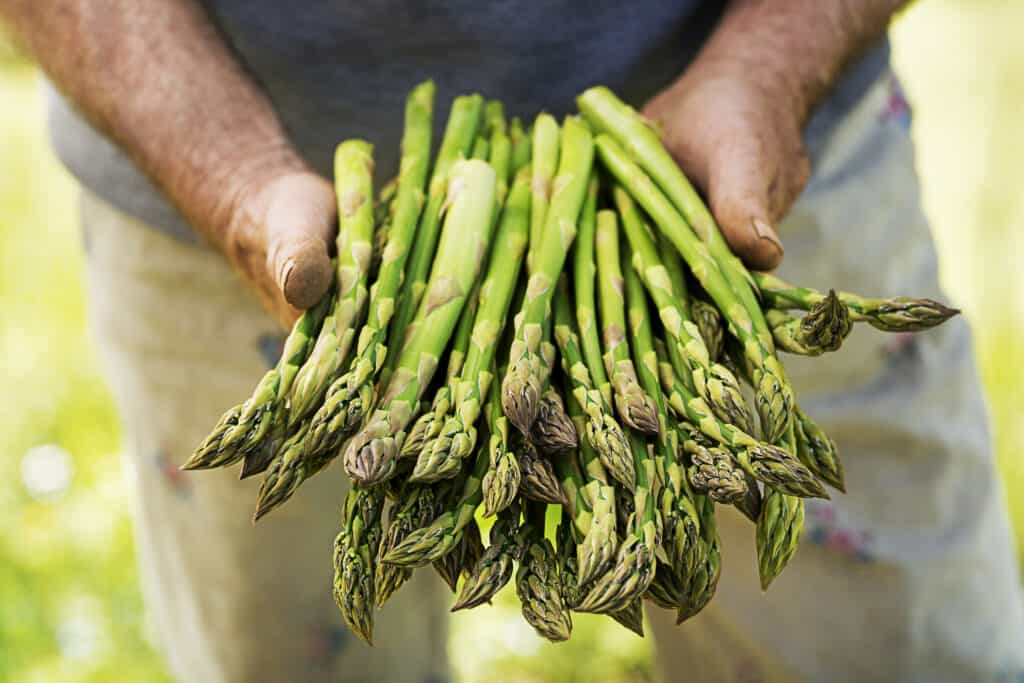
- Cut spears when they are 6 to 10 inches (15-25cm) tall and at least the diameter of a pencil. Tips should be firm and closed.
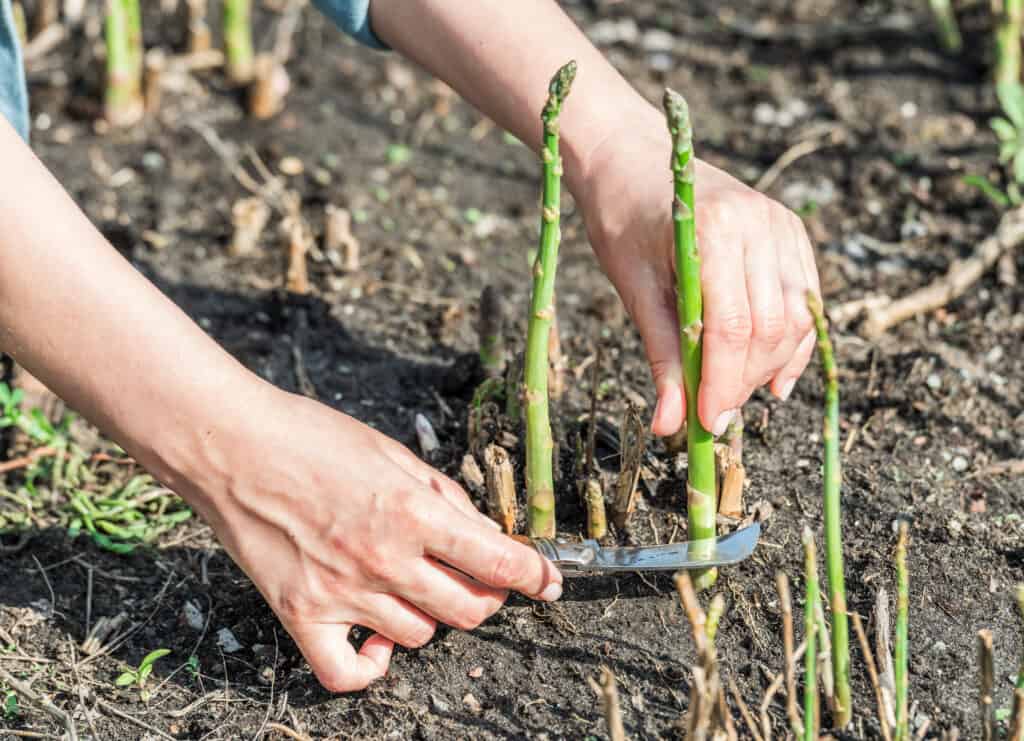
- Snap spears off at soil level with your fingers at or just below ground level. If you use a knife, be careful not to injure nearby crowns.
- When spear bracts begin to feather out, it is too late to eat them.
- If temperatures approach 90°F (32°C) at harvest time, harvest daily; heat can cause bracts to open prematurely.
- Lengthen the harvest season of young spears over 3 to 4 years; production can be diminished if the plants are overharvested early. Don’t harvest the second year after planting. Waiting until the third season allows plants to establish healthy root systems. Limit the number of young spears you take in the third year after planting; increase the number each year for another three to four years.
More tips on growing asparagus: Asparagus Growing and Care Calendar.
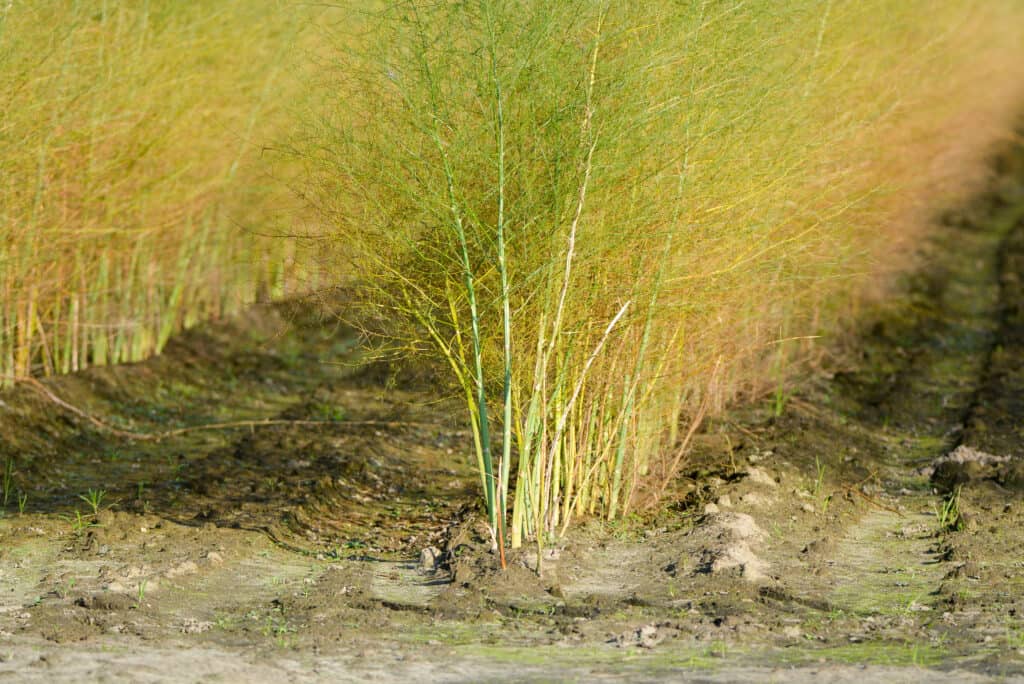
How to harvest asparagus twice a year
- To extend the harvest, plant twice as many plants.
- Harvest half of the plants as usual from spring to early summer.
- Let the other plants/spears grow on; they will grow on to become tall ferny plants.
- Just after the middle of summer (in late July) cut the ferny plants down to the ground.
- New spears will emerge in early fall; harvest these spears like you would spring spears. Complete the second harvest before early winter or the arrival of frost and freezing weather.
Asparagus in the kitchen
- Asparagus can be eaten raw, parboiled, steamed, boiled, baked, roasted, and grilled.
- Server asparagus with oil and vinegar.
- Steam asparagus quickly or cook it upright in a pan so that stems cook faster than the tender tips.
- Serve fresh asparagus with melted butter.
- Dress asparagus with chive mayonnaise, mustard butter, or a caper butter sauce.
- White asparagus is asparagus that has been blanched during the growing process. It is slightly sweeter than green asparagus and has less fiber.
- Purple asparagus is asparagus that has been bred for the color purple. ‘Purple Passion’ is a purple variety. Purple asparagus turns green when cooked. The spears are usually thicker than green varieties.
- Asparagus is rich in vitamins B and C, and also iron and calcium.
Storing and preserving asparagus
- Asparagus is best used fresh.
- Asparagus will keep for up to 1 week in the refrigerator. Place asparagus spears upright in a jar with an inch or so of water. Place a plastic bag over the top of the spears.
- Freeze asparagus after blanching. Blanch asparagus in a large pot of boiling water for a minute or a bit more, then place the spears in an ice bath with a slotted spoon. Drain in a colander and allow to air dry before flash freezing on a sheet pan. Store in a freezer bag for up to a year.
- Asparagus can be canned using a pressure cooker.
- Asparagus can be dried in a dehydrator
More on How to Harvest and Store Asparagus.
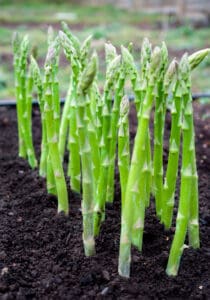
Asparagus varieties to grow
Asparagus are monoecious plants meaning each plant is either male or female. Male plants are more productive. Many hybrids that are all male have been developed. Heirloom varieties are often a mix of male and female plants.
To know if a plant is male or female: when flowers appear use a magnifying glass to look at the flowers. Female flowers have pistils with 3 lobes.
- AsparaBest’ (male): Heavy producer; cold tolerant.
- ‘Jersey Knight’ (male): heavy producer; resistant to most asparagus diseases; hardy in very cold winter regions; mostly male plants.
- ‘Jersey Giant’ (male): very good flavor; high yield; predominantly male; grows well in the East and Midwest.
- ‘Jersey Supreme’ (male): early producing; cold-tolerant and diseases resistant; male plants.
- ‘Larac’ (male/female): pale, nearly white, French cultivar.
- ‘Mary Washington’ (female): heirloom traditional variety; produces long, thick, and tender shoots; rust-resistant; heirloom variety.
- ‘Millennium F1’ (male): grows well in very cold northern gardens.
- ‘Pacific Purple’: bright purple spears; mild flavor.
- ‘Precoce D’Argenteuill’ (male/female): rose-colored buds; heirloom variety.
- ‘Purple Passion (male/female): sweet, tender, colorful purple asparagus. The purple sprouts turn green when cooked.
- ‘Sweet Purple’ is hybrid purple asparagus.
- ‘UC 157’ (male): a good choice for West Coast weather; heavy producer–grown commercially; Fusarium tolerant, rust tolerant.
- ‘UC 72’: Mary Washington-type; heat and drought tolerant; Fusarium and rust tolerant..
- ‘Viking’ (male): excellent for cold climates, tender, tasty.
Asparagus frequently asked questions
Q: Where will asparagus grow?
A: Asparagus is a perennial that will grow in nearly all regions of the United States except the very coldest North, the Deep South, and Southern California. It needs cold winters and can withstand temperatures of -40°F. It does not like warm winters and humid weather.
Q: How should I start an asparagus bed?
A: Prepare a planting bed in late fall. Spread lime over the planting bed if you have very acidic soil, then dig in lots of compost and well-rotted manure 24 inches into the ground. The following spring, dig trenches 8- to 10-inch deep in the bed and set in the root crowns, 12 inches apart. Gradually fill in the trench once the plants are actively growing take care not to cover the growing tips.
Q: How do I care for my asparagus bed?
A: Mulch with organic material, such as compost, that will feed the soil and keep the weeds down. Weed regularly if you don’t weed often. If you have acidic soil, spread lime generously on either side of a planting row or trench a few days before fertilizing in the spring. Fertilizer again with an organic fertilizer after the harvest period. If you live in a cold-winter region, mulch thickly before winter comes; then pull the mulch aside in early spring so the ground can warm up faster.
Q: Is there a limit to how much asparagus you can harvest?
A; Don’t harvest any spears during the first year of growth from roo crowns (or the first two years of growth from seed). Harvest lightly from root-crown plantings the second spring. If the spears are thin, don’t harvest them at all. Start cutting spears in earnest the third year, and never miss fertilizing in spring. Cut the spears just below ground level when they are about a finger’s thickness. Leave the skinny spears to grow into ferns that will nourish the plant. Don’t harvest after midsummer.
Q: What are some good rust-resistant varieties of asparagus?
A: Mary Washington and Waltham Washington are asparagus varieties with good rust disease resistance.
Q: How can I grow white asparagus?
A: Blanch emerging spears by covering them with heaps of light, organic mulch such as chopped leaves.
Q: Can asparagus be grown in a container garden?
A: Because asparagus spears do not grow to productive size for 3 years, container growing asparagus may not be worth the effort. That said, yes, asparagus can be grown in a container.
Q: Is asparagus related to the asparagus fern houseplant?
A: Asparagus ferns (Asparagus densiflorus) are closely related to edible asparagus (Asparagus officinalis). Asparagus ferns are commonly grown as houseplants. They don’t produce anything we can harvest and eat. The most commonly grown asparagus fern is ‘Sprengeri.
About asparagus–fast facts
- Plant type: Asparagus is a hardy perennial that produces tender, fleshy, green stems or “spears” with bud-forming caps. Asparagus are monoecious plants meaning each plant is either male or female. Male plants are more productive. Many hybrids that are all male have been developed. Heirloom varieties are often a mix of male and female plants.
- Common name: Asparagus
- Botanical name: Asparagus officinalis
- Family: Liliaceae –onion family; relatives include garlic, onions, scallions, and shallots
- Origin: Mediterranean
- Harvest time: Edible spears are harvested 2 to 3 years after planting, 3 is preferable
- Foliage: Grown to maturity the asparagus has fernlike, feathery foliage.
- Life expectancy: The asparagus is long-lived staying in the garden for 15 years or longer.
- Light: Full sun is best
- Water: Keep the soil evenly moist, not wet
- Soil: Loamy soil rich in organic matter that is well drained
- Fertilizer: Feed with compost tea or granular organic fertilizer high in potassium and phosphorus
- Pests: Cutworms, slugs, asparagus beetles, asparagus miners, aphids, thrips
- Diseases: Asparagus rust, Fusarium root and crown rot
Asparagus Growing Hub
Start here: The Ultimate Asparagus Growing Guide: From Seed to Harvest
Planting & Establishment
- When to Plant Asparagus by USDA Zone
- How to Plant Asparagus
- How to Select the Best Asparagus Plants and Crowns
- Starting Asparagus from Seed Indoors: Step-by-Step Guide
- Direct Sowing Asparagus Seeds Outdoors
- Planting Asparagus Crowns Outdoors: A Beginner’s Guide
- Male vs. Female Asparagus Plants: What’s the Difference?
- How to Transplant Asparagus Without Damaging the Roots
Care & Maintenance
- The Best Companion Plants for Asparagus and What to Avoid
- How to Water Asparagus for Healthy Growth
- Fertilizing Asparagus: Feeding Tips for Bigger Harvests
- Seasonal Asparagus Care: Spring, Summer, and Fall Tasks
- How to Blanch Asparagus for White Spears
- How to Protect Asparagus from Winter Cold
Pests & Diseases
Harvest & Storage
- When and How to Start Harvesting Asparagus Spears
- How to Harvest and Store Asparagus
- Asparagus Harvest Schedule: Year-by-Year Guide
- How to Harvest Asparagus Twice a Year
Kitchen & Varieties
- Seven Ways to Cook and Serve Asparagus
- How to Cook Asparagus with No Recipe
- Canning the Asparagus Harvest
- Top Asparagus Varieties to Grow in Your Garden
Asparagus articles at Harvest to Table:
How to Harvest and Store Asparagus
Seven Ways to Cook and Serve Asparagus
How to Cook Asparagus with No Recipe
Asparagus Growing Problems Troubleshooting
Asparagus Beetle Organic Pest Control
More tips: Asparagus Planting Tips.
Grow 80 vegetables and herbs: THE KITCHEN GARDEN GROWERS’ GUIDE
More how to grow articles:
Learn how to plant, grow, and harvest your favorite vegetables. Click below for all you need to know.
- Artichoke
- Arugula
- Asparagus
- Beans, Snap
- Beets
- Broad Beans
- Broccoli
- Brussels Sprouts
- Cabbage
- Cantaloupe — Melons
- Cardoon
- Carrots
- Cauliflower
- Celeriac
- Celery
- Chard
- Chayote Squash
- Chickpeas
- Chicory
- Chinese Cabbage
- Collards
- Corn Salad
- Corn, Sweet
- Cresses
- Cucumbers
- Eggplant
- Endive and Escarole
- Fava Beans
- Florence Fennel
- Garbanzo Beans
- Garlic
- Horseradish
- Jerusalem Artichoke
- Kale
- Kohlrabi
- Leeks
- Lettuce
- Lima Beans
- Melons
- Mizuna
- Mustard Greens
- New Zealand Spinach
- Okra
- Onions
- Parsnips
- Peanuts
- Peas
- Peppers
- Potatoes
- Pumpkins
- Radicchio
- Radishes
- Rhubarb
- Rutabaga
- Salsify
- Shallots
- Sorrel
- Southern Peas
- Soybeans
- Spinach
- Squash, Summer
- Squash, Winter
- Sunchokes
- Sweet Potato
- Swiss Chard
- Taro
- Tomatillo
- Tomatoes
- Turnips
- Watermelon
- Zucchini