Stephen Albert

Parsley root can be steamed, boiled, puréed, or creamed. Use parsley root in braises, soups, stews, and vegetable mixes to add depth and aroma.
The flavor of parsley roots is somewhere between celeriac and carrot with hints of celery, turnip, and parsley leaf.
Parsley root works particularly well in combination with other roots and tubers such as carrots, potatoes, turnips, and onions.
Parsley root is also called Hamburg parsley, Dutch parsley, and turnip-rooted parsley.
Parsley root is harvested from late summer to spring. A touch of frost will improve its sweetness and flavor.
How to choose parsley root
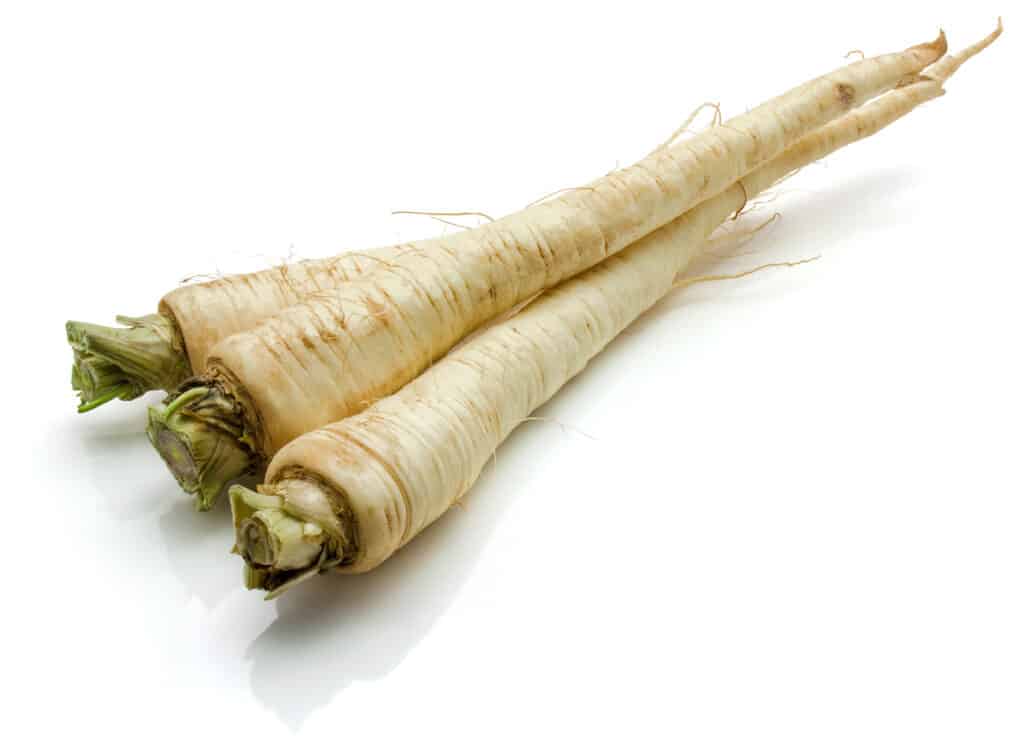
- Select parsley roots that are firm, creamy-beige, unblemished, and about the same size. The best-tasting roots will be small to medium-sized. Avoid withered roots.
- Parsley root leaves should be feathery and bright green. Roots with leaves that are limp or wilted are not fresh. Do not trim off the leaves until you are ready to use the roots.
How to store parsley root
- Parsley root will keep in the refrigerator for up to a week if you first wrap it in a paper towel and place it in a plastic bag. The leaves will keep for just 1 or 2 days.
How to prep parsley root
- To prepare parsley root for cooking remove the leaves and fine roots and then gently scrub with a brush to remove any soil. The peel is tasty so don’t peel or scrape off the skin.
- Trim off the greens, wash and dry them and reserve for use like regular parsley.
Parsley root serving suggestions
- Parsley root is most often eaten cooked, but it can also be eaten raw.
- Small roots can be used raw whole, sliced, diced, or shredded in a winter salad. Shredded parsley root and celeriac combine well for a raw salad. Sprinkle cut areas with lemon juice to prevent discoloration.
- Dried roots can be used as a flavoring: dry them on a shallow baking tray in an oven heated to 170°F (77°C); cool before storing them in an airtight jar in a dark place.
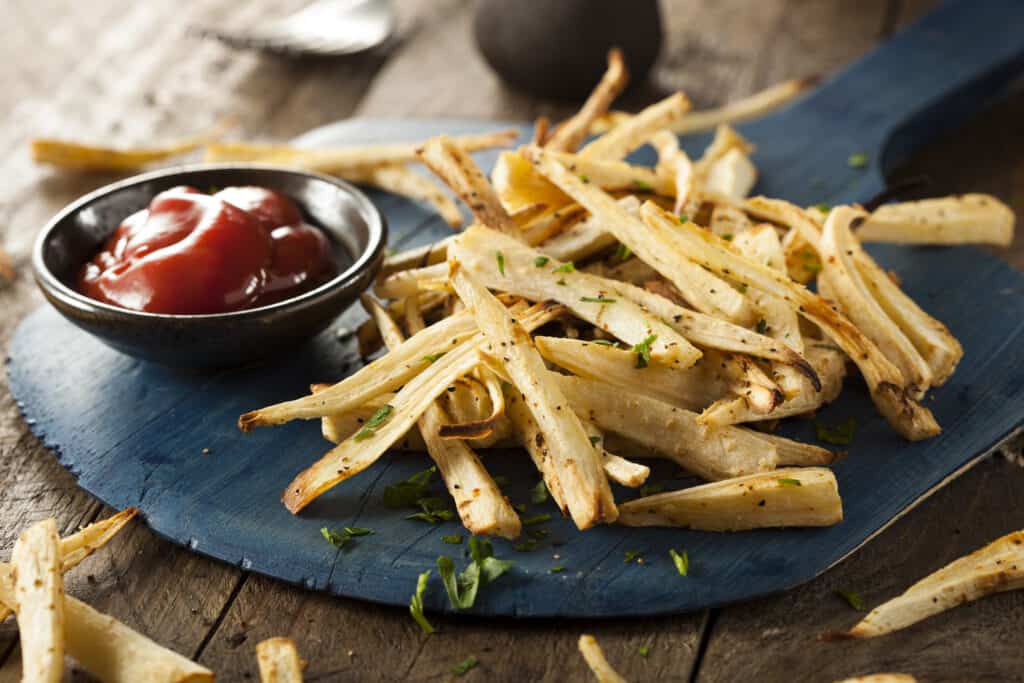
Parsley root cooking suggestions
- Cook parsley root sliced or cubed like you would other roots such as turnips, parsnips, and carrots or like you would celeriac or asparagus.
- Roast, sauté, fry, boil, steam, or add parsley root to soups and stews. Prepare parsley root by itself creamed, puréed or simply steamed or boiled and buttered.
- Use one part boiled parsley root to 3 parts boiled potatoes and mash.
How to steam parsley toot
- Place a steamer basket in a saucepan. Add water to just below the bottom of the basket.
- Bring water to a boil.
- Add 1 pound of prepped parsley root to a steamer basket. Cover and reduce heat.
- Cook the parsley root until crisp-tender. Quater-inch slices will take 8 to 10 minutes. Quarter-inch strips will take 5 to 7 minutes.
How to boil or simmer parsley root
- Bring slightly salted water in a saucepan to a boil.
- Add 1 pound of parsley root; cook until crisp-tender. Quarter-inch slices will take 7 to 9 minutes. Strips will take 4 to 6 minutes.
- Drain parsley root and season to taste with salt and pepper.
How to purée parsley root
- Boil the parsley root as directed above.
- Drain the parsley root and put them through a blender, sieve, or food mill.
- Whip with butter and seasonings. for 2 pounds of parsley root whip with 4 to 6 tablespoons of butter. If the mixture is on the dry side, beat with boiling milk as well as butter.
Parsley root flavor partners
- Parsley root partners well with barley, beets, cabbage, chicken soup, horseradish, oxtail, root vegetables, shallots, sweet potato, and thyme.
Parsley root nutrition
- Parsley root contains vitamin C and iron. It is high in sodium.
Parsley root health note
- The leaves and roots of wild parsley root resemble the leaves and roots of hemlock which is poisonous.
Get to know parsley root
- Parsley root can be eaten cooked or raw.
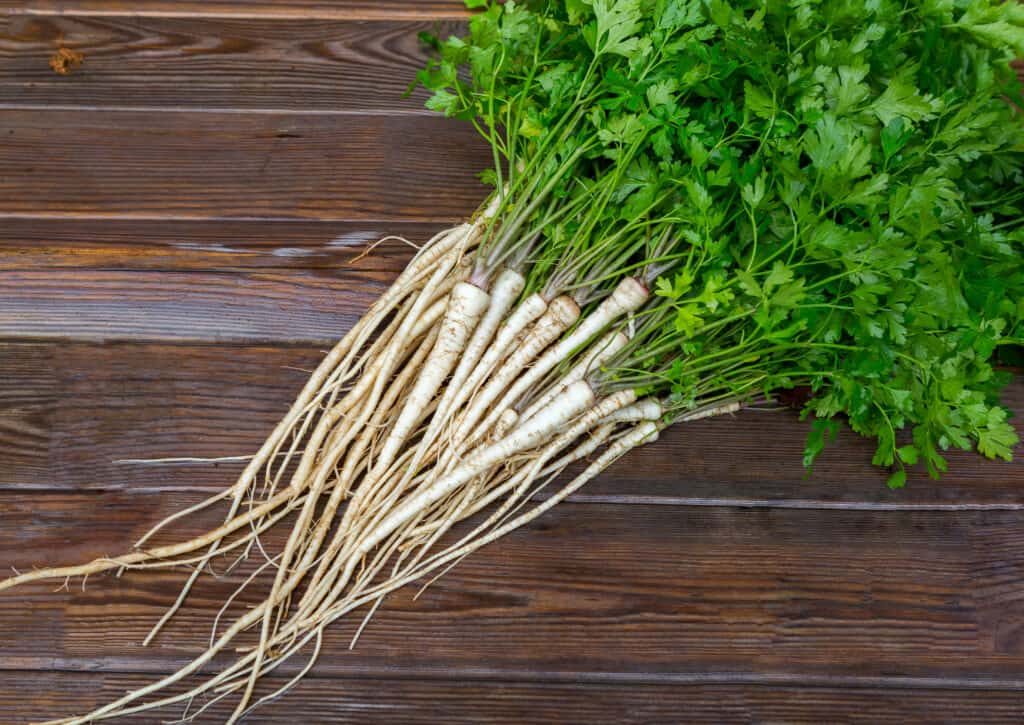
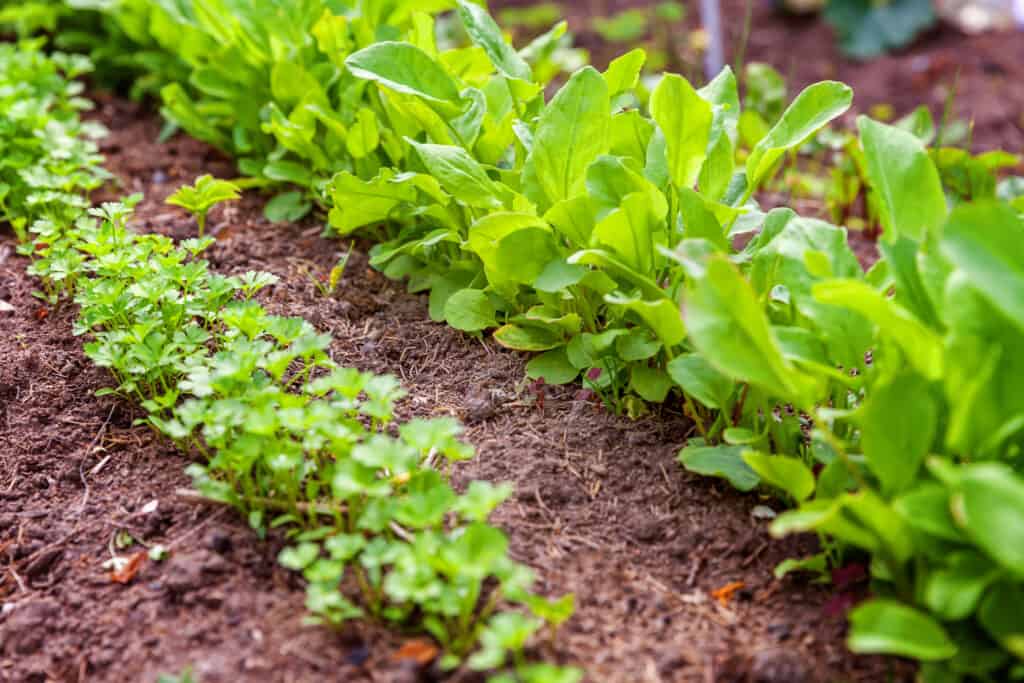
- Parsley root is a biennial grown as an annual. Parsley root has a carrot-shaped, beige-white root.
- Its tapering root resembles salsify or a small parsnip—the root growing about 6 inches (15 cm) long and 2 inches (5 cm) wide. It is often double-rooted.
- Parsley root has large Italian parsley-like leaves—finely cut, flat, and dark green.
- The leaves of parsley root are coarse-textured and can be used as a garnish.
- It is most popular in central Europe—Austria, Hungary, Poland, and Germany—and in Russia and Holland. It is one of several vegetables and herbs known in Germany as suppengrun or soup greens which are combined with beef or poultry and boiled and used as soups and sauces.
- Parsley root was first used for cooking in Germany in the sixteenth century. That is where it got the name Hamburg parsley.
The botanical name for parsley root is Petroselinum crispum var. tuberosum.
Articles of interest:
Best Herbs for Container Growing
Garden Planning Books at Amazon:
- Vegetable Garden Almanac & Planner
- Kitchen Garden Grower’s Guide Vegetable Encyclopedia
- Vegetable Garden Grower’s Guide
- Tomato Grower’s Answer Book
More kitchen tips:
Bring your harvest to the table. Kitchen prep tips and easy recipes for the vegetables you grow. Click below for vegetable prep and recipes you can use now.
- Almonds
- Apples
- Apricot
- Aprium
- Artichoke
- Arugula
- Asparagus
- Avocado
- Bamboo Shoots
- Banana
- Basil
- Beans, Dried
- Beans. Long
- Beans, Shell
- Beans, Snap
- Beets
- Bitter Melon
- Blackberry
- Bok Choy
- Broccoli
- Broccoli Raab
- Brussels Sprouts
- Cabbage
- Cardoon
- Carrots
- Cauliflower
- Celeriac
- Celery
- Chard
- Chayote Squash
- Cherimoya
- Cherries
- Chestnut
- Chickpea
- Chinese Cabbage
- Chives
- Cilantro
- Citron
- Clementine
- Collards
- Coriander
- Corn, Sweet
- Corn, Baby
- Corn Salad, Mache
- Cranberry
- Cress
- Cucumber
- Daikon
- Dandelion
- Dill
- Eggplant
- Endive, Belgian
- Endive and Escarole
- Fava Beans
- Fig
- Florence Fennel
- Garlic
- Ginger
- Grapefruit
- Grapes
- Guava
- Horseradish
- Jerusalem Artichoke
- Jicama
- Jujube
- Kale
- Kiwifruit
- Kohlrabi
- Kumquat
- Leeks
- Lemongrass
- Lemons
- Lettuce
- Lime
- Mache (Corn Salad)
- Mandarin Orange
- Mango
- Maple Syrup
- Marjoram
- Melons
- Michihili
- Mint
- Mizuna
- Mushrooms
- Mushrooms, Cremini
- Mustard Greens
- Napa Cabbage
- Nectarine
- Okra
- Olives
- Olive oil
- Onions
- Oranges
- Oregano
- Parsley
- Parsley Root
- Parsnips
- Passion Fruit
- Pawpaw
- Peaches
- Pears
- Peas, Garden Snap
- Peas, Snow
- Pei Tsai
- Peppers, Chili
- Peppers, Sweet
- Persimmon
- Pineapple
- Pineapple Guava
- Plantain
- Plums
- Pluots
- Pomegranate
- Potatoes
- Prickly Pear
- Pumpkin
- Quince
- Radicchio
- Radishes
- Raspberries
- Rosemary
- Rhubarb
- Rutabaga
- Sage
- Salsify
- Sauerkraut
- Savory
- Shallots
- Sorrel
- Spinach
- Squash, Summer
- Squash, Winter
- Strawberries
- Sunchokes
- Sunflower
- Sweet Potato
- Swiss Chard
- Tangerine
- Taro
- Tarragon
- Thyme
- Tomatillo
- Tomato
- Turnip
- Turnip Greens
- Yams